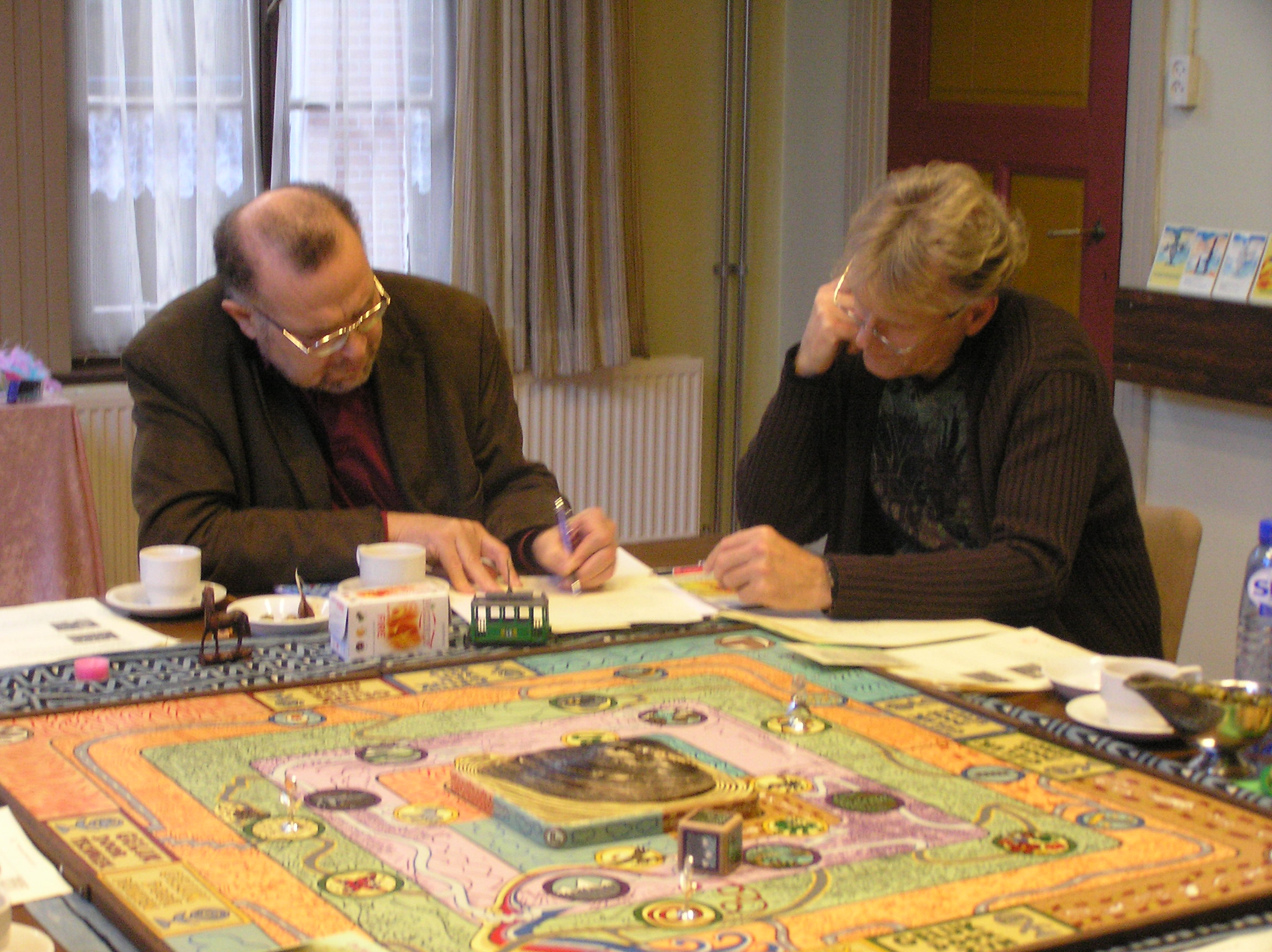
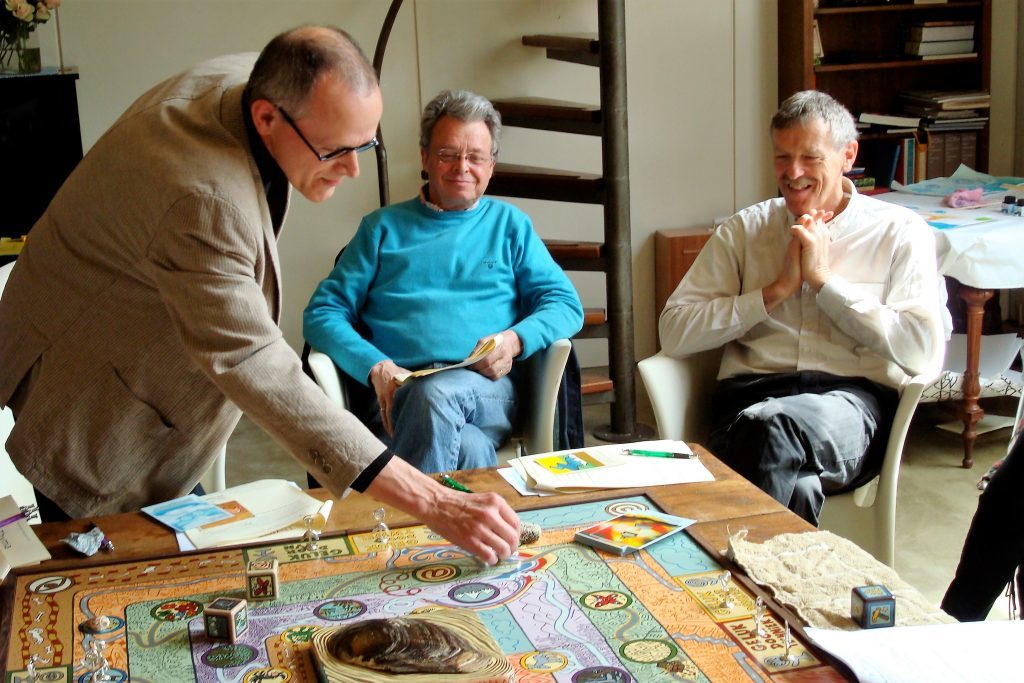
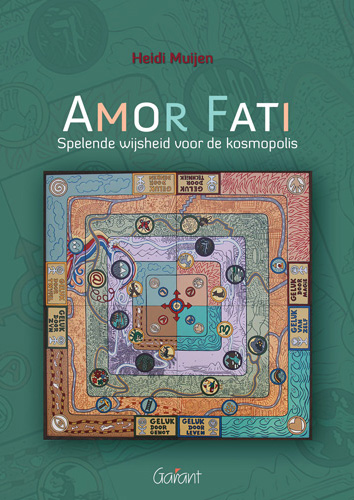
Amor Fati is a board game — as well as a book on the intercultural vision and mission of the Quest for Wisdom — in which you re-enact and reflect on life as a journey through a colourful landscape full of symbolism, picking up intercultural visions and mythical wisdom about the journey of life along the way. How the picked wisdoms enrich your vision on life, you share with your mates in the group, so that you deepen each other’s insights. As a result, the game stimulates both personal growth and offers an exercise for the art of living as a world citizen.
Lecturer in Guidance Science Michiel de Ronde about Amor Fati:
“I see your work as a significant re-evaluation, also a recalibration, of the premodern era. All those profound insights and life-creating practices that were often either worshiped or cursed along a vertical axis, you present in a deep perspective of an infinitely horizontal mythical-human field, allowing the world to become a home for all and enabling people to meet each other based on recognition and appreciation.”
Chief Trainer of the Master of Arts Therapies and retired lecturer Henk Smeijsters about the book Amor Fati:
“I find your book impressive, rich in information, and meaningful symbolism.”
In QfWf-Circles the seven rounds of the game and the book Amor Fati were performed from summer 2025 till summer 2026 by means of creative excercises, helping to reflect on the seven life theme’s as an art of living – with special attention to (the unveiling of your) mask as symbol for the elementary art of living as world citizen – in the complex context of intercultural encounters, as an inner journey along the symbols on the game board, by means of Amor Fati Arts Dialogues!
The Board-game Amor Fati
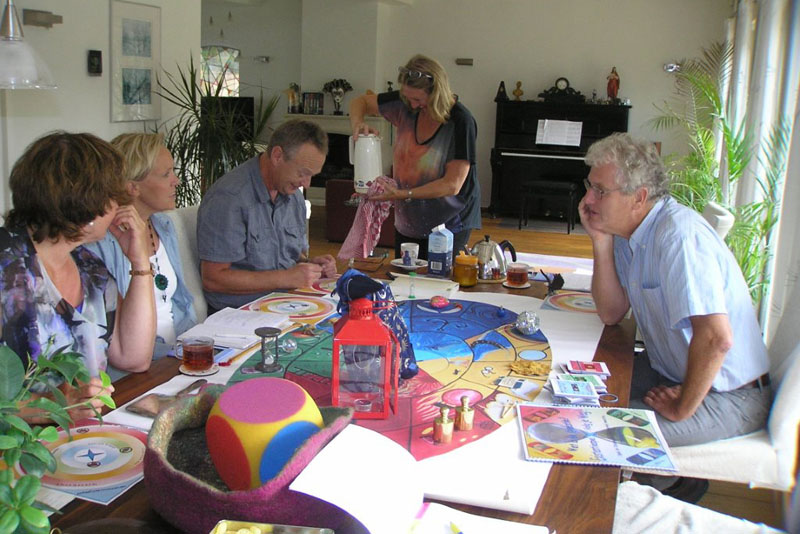
Around the colourful game board, a group of friends, family or team might go on a inward journey — while exchanging each others view on happiness in life — if one of the players wants to be the game and dialogue facilitator by means of the Game Guide. Also, it is possible to practice the art of living of amor fati under the guidance of a Quest for Wisdom-game supervisor
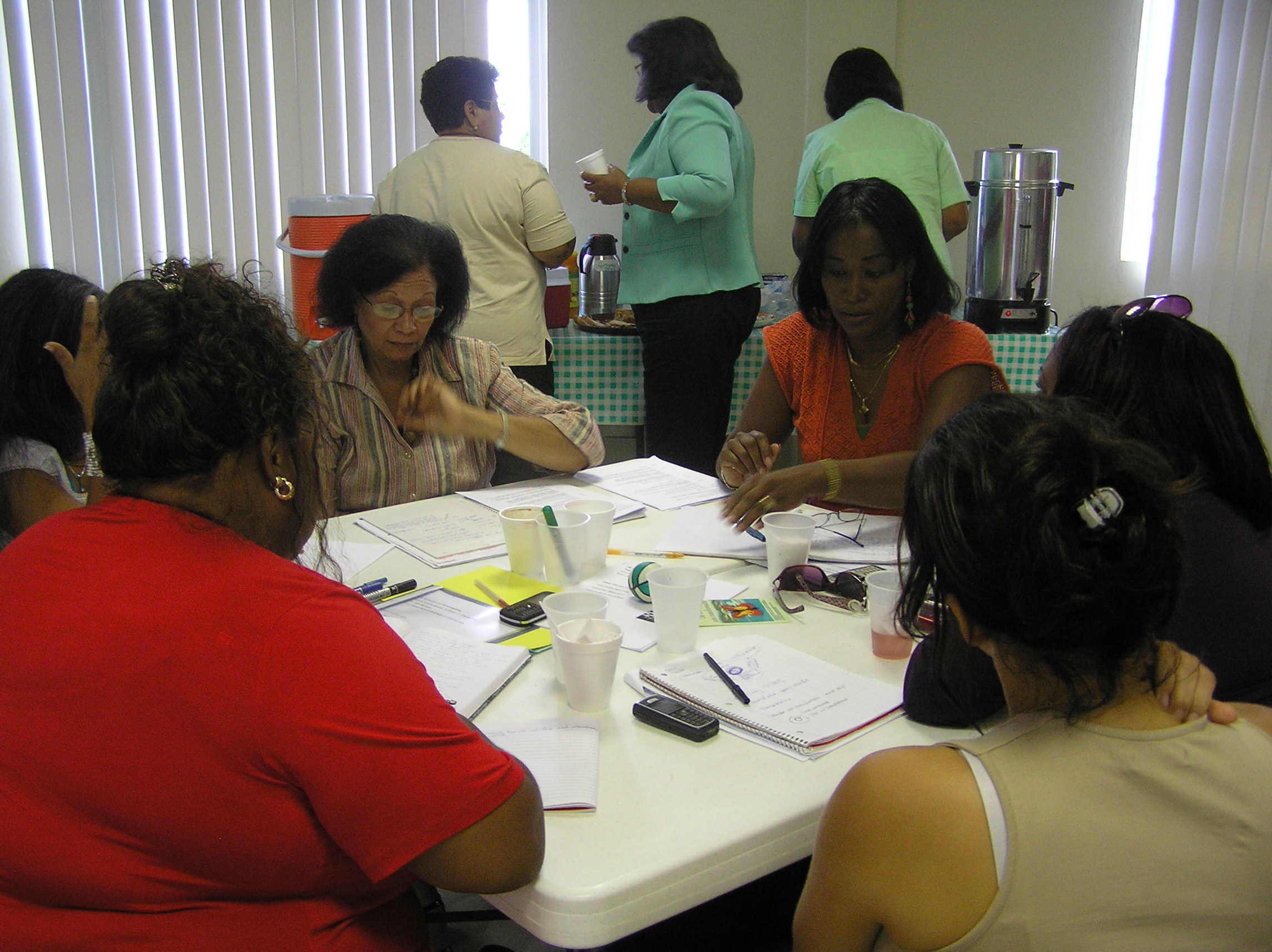
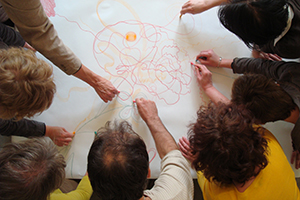
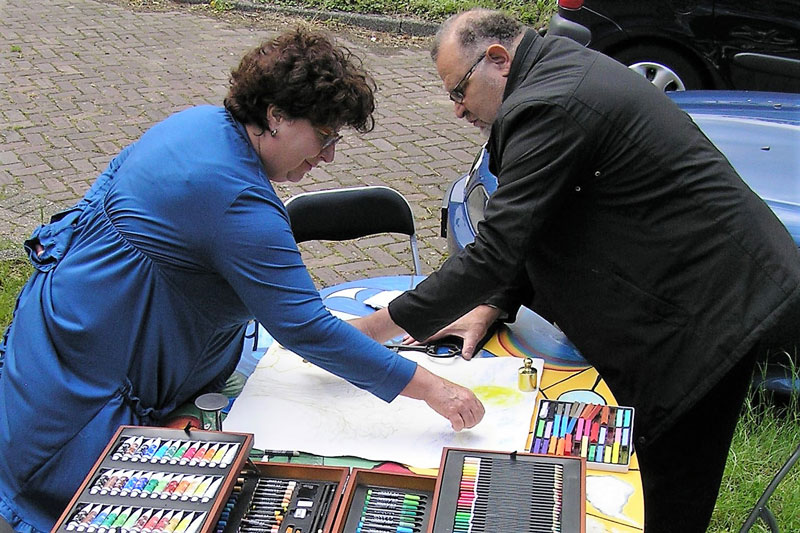
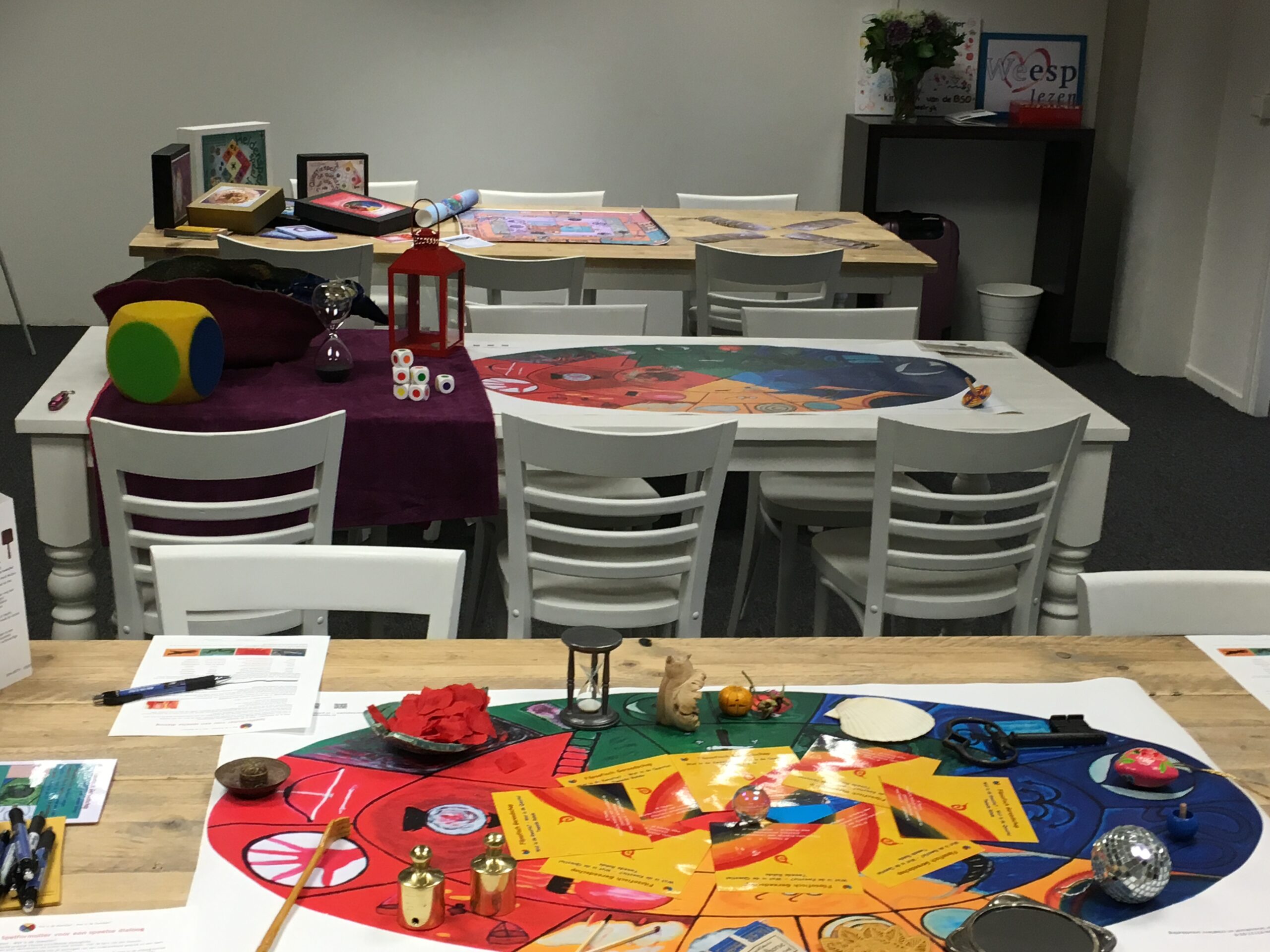
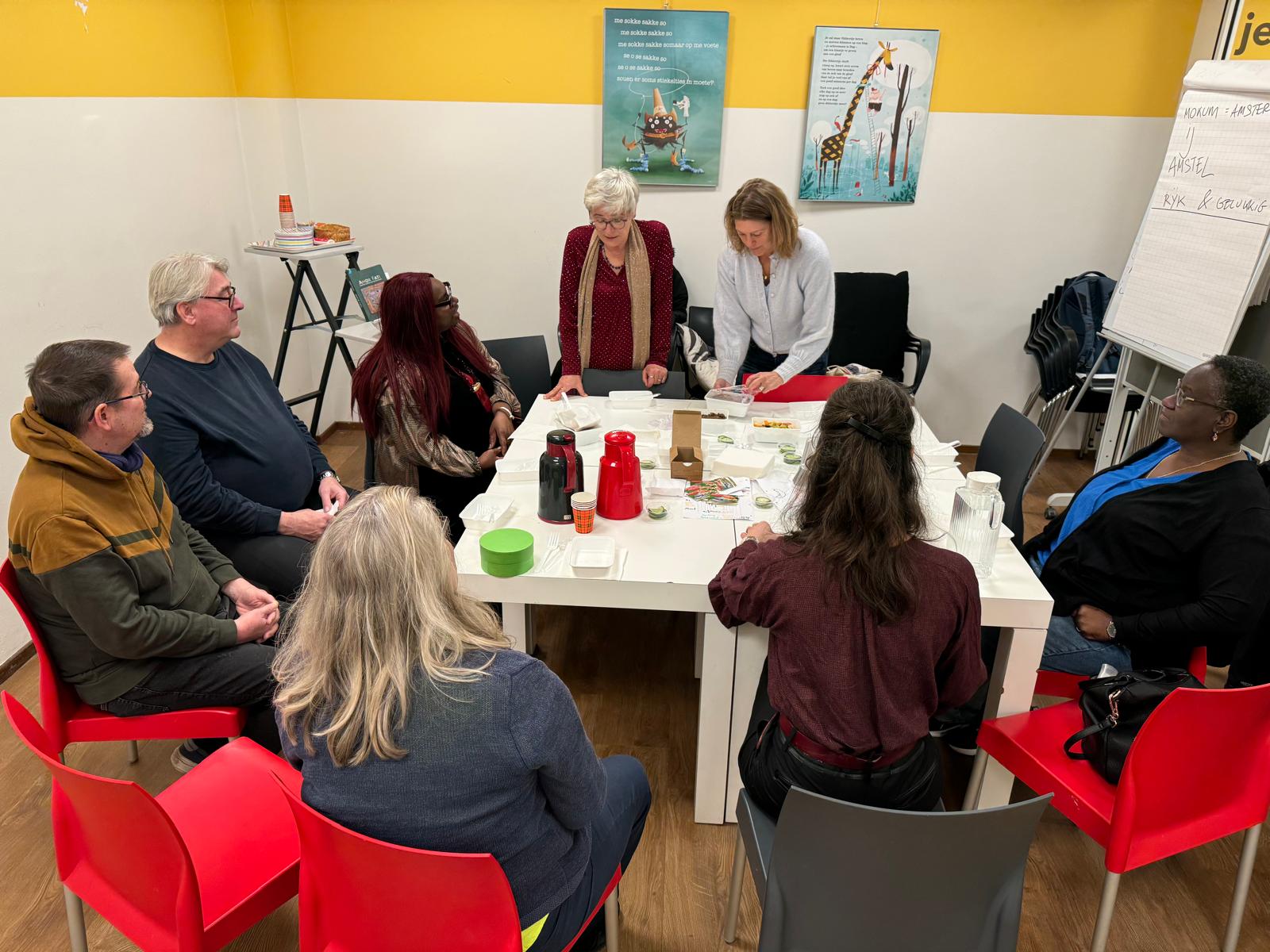
Sitting around the Play Table with creative materials.
Two counsellors and world citizens have written a wonderful reflection, one in images and one poetical, on their journey towards happiness through the landscape of the art of living.
Amor Fati is a board game with 7 card sets, playing figures, rings, natural elements, dice, hourglass, spinning top, quintessence-shell and a game guide: ISBN: 9789492127167
Duration: depending on your wishes and possibilities, two to eight half-days, in a small group of 2 to 8 players.
Dialogue and Imagination
Imagination opens doors to unknown possibilities
Amor Fati introduces players to the intercultural art of living; its name being derived from the classic motto of the art of living, literally meaning ‘the love of life’s fate’. The journey towards your destiny in life is captured in symbolic signposts to different wisdom traditions from the four cardinal directions. The power of this board game consists in playing together and engaging in dialogues. Both serious and with fun as a dynamics between contemplation and playful interaction by throwing the dice and spinning the toll, resulting in surprise about which symbol one lands on (your destiny, fate or coincidence?).
All these aspects contribute to a deepened understanding: the symbolism on the playing field appeals to the imagination and the game assignments call for alignment with your moral compass and trigger both reflection as well as exchange with the others from the playing group. It is precisely this tapping into all the sources within oneself and in-between each other, reflecting what life has in store for us, that nurtures the actual handling of essential questions that life poses on us.
Playing: both educative and having fun together
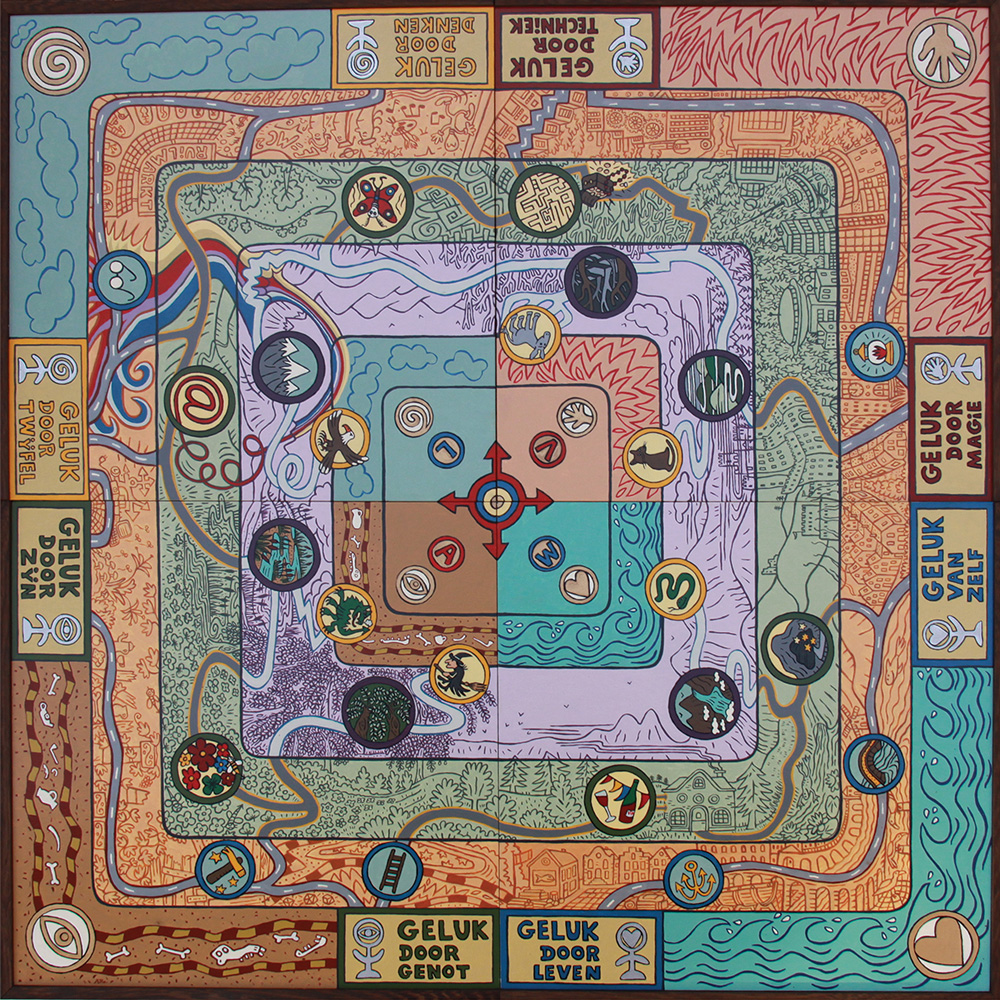
Each concentric circle on the playing field represents a theme of life, which is addressed by means of the symbols in each circle. Wandering over the symbolic landscape, you will encounter intercultural symbolism in stories, questions and quotes on the playing cards. For example, players will be asked to wonder about enigmatic questions; comparable to koans — paradoxical statements such as “What is the sound of one clapping hand?”, which students receive from their Buddhist teacher — and to philosophical ‘aporia’ (ancient Greek for desperation) and riddles to which you may give several but no conclusive answers. You are called for dialogue with oneself and exchange with your group mates, and harvest what is meaningful to you in each game round on the game sheet.
Finding your destiny between freedom and determination
Training with the playing cards on Curaçao
The journey across the playing field triggers the tension between the coercion of fate and the freedom to steer your life as actor. In the game, players experience this tension by throwing the dice and the call to interpret the symbol on their path. For example, by wondering “What does the dark forest on my card mean for the theme I’m investigating in the game?“. In this way, players are stimulated to reflect on the paradox of being thrown into situations and giving meaning to it as author of your life.
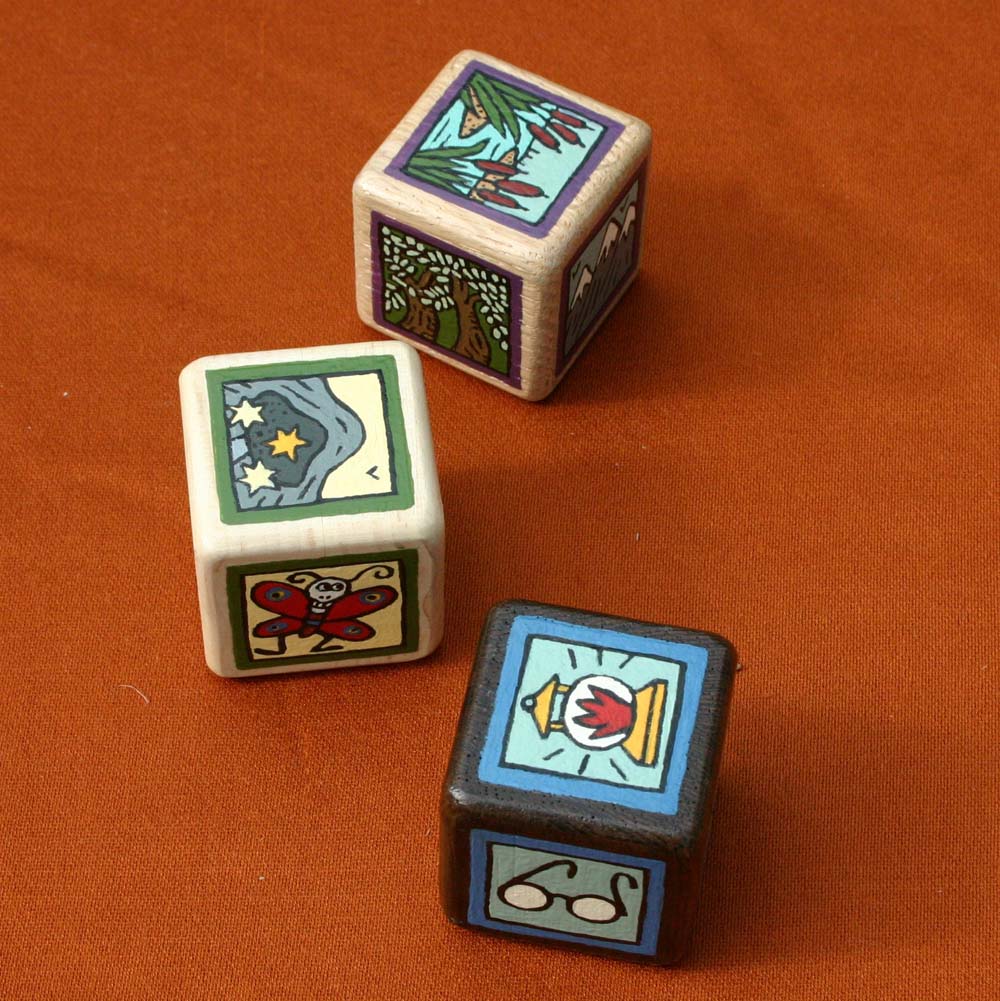
Dice: representing fate
The art of living of amor fati consists of the call to reconcile these two poles and to embrace being ‘thrown’ into situations and to live a meaningful life: by throwing the dice, giving meaning to the assigned symbol.
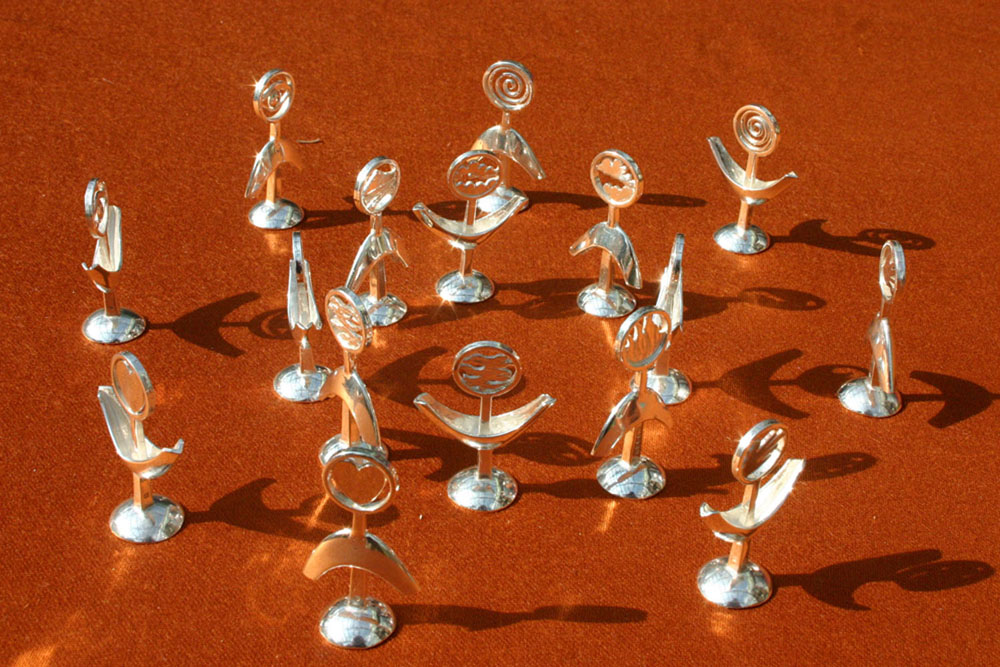
Playing figures with the basic symbols and orientation in life
Players practice the art of living while wandering along the paths as in a labyrinth, towards the mysterious quintessence in the centre of the game board. What do the symbols mean to you? How to give meaning to the intercultural wisdom on the cards, you get as signposts on your journey? This travelling along the game board makes you feel the existential tension between the coercion of destiny and the freedom to shape life yourself.
Meandering through seven stages (game rounds)
Pregame Round; players give voice to their question or theme in life and choose one of the four natural elements and a basic attitude in life, visible in the figure with the arms down for an alert following orientation or with the arms raised for a sensitive entrepreneurial life-based attitude.
The outer circle around the theme of Authenticity shows eight starting positions in the game as frames of thinking with a principle of happiness. These positions connect the roads in the game to one of the natural elements and the corresponding basic symbol eye, heart, spiral, hand.
The orange circle of Bildung (Education) is about how to find a good course in the dynamics between nature and culture, as well as intercultural contexts: players are given a philosophical tool, by means of six symbols that depict intercultural perspectives from different wisdom traditions.
The green circle represents the constant dynamics in life of Ups & Downs; heading towards the centre, players pass one of the six mythical places, which connect the good life with the tragic side of life, in order to align their inner compass – this is made visible by the Rings of moral motives.
the game-board with seven rounds
The purple circle of challenges in life invites the players t0 continue their journey and find themselves in one of the six landscapes of elemental imbalance, by which they are metaphorically confronted with the question how do I deal with a crisis in life?
The in-between Round of Encountering ‘the strange other’: here, the question at stake is whether you tend to ‘keep everything under control’ in a crisis situation or whether you are willing to accept help. Do you want to meet the mythical creature or animal that lives here and can offer you a different perspective on the journey of life?
The inner circle of finding your Destination. What does it mean to you that the centre with the four quadrants are of the same colours and show the same elemental symbols as the outer circle? Are you back to your start position and choice of one of the four elements? Or is your perspective tilting from having to earn happiness towards being happy! How does your basic element open the gateway to the quintessence?
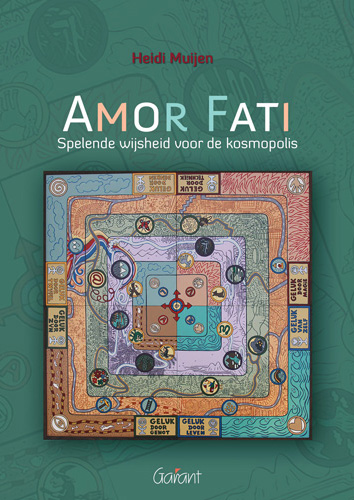
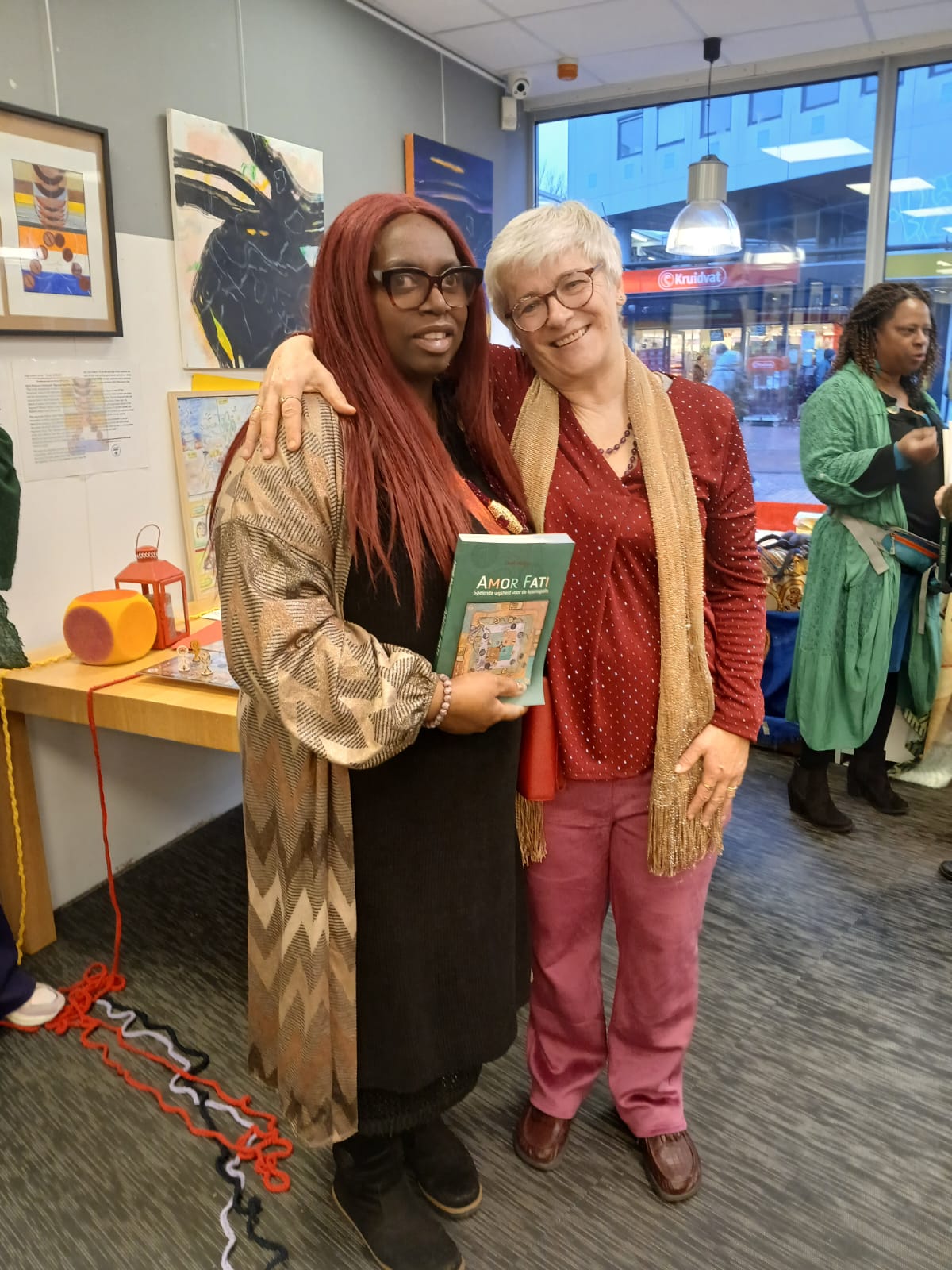
In the book of the same name, Amor Fati: Playing Wisdom for the Cosmopolis, Heidi Muijen provides background for the game as well as for the QfWf philosophy about the Wheel of the Intercultural Art of Living. This full-colour edition with English intercultural reflections by Greg Suffanti on his watercolour series – together with the visual work of Agnes Roothaan, who painted the game-board, Louis van Marissing who made the icons for the Wheel of the Intercultural Art of Living, Annelie van Steenbergen, Caroline Young, Nour Kayali, Klaske Rehorst, Josee Tesser, Elin Maljaars, Maya Plas & Mitra Muijen around the mythical-philosophical themes of Amor Fati – give the reader a surprising route of the imagination through the book. Amor Fati is a co-production with publisher Garant, 499 pages.
NL/EN 2024, ISBN 978-90-441-3970-9
Amor Fati (game and book) wants to appeal to people with an open mind and a warm heart for the world. People with an interest in wisdom traditions as well as natural wisdom that arises from good conversation, living encounters and teamwork. Encounters between people ensure cross-pollination between their cultural backgrounds: a vital lifeline for the cosmopolis. This ideal of ‘the cosmic city’ — the ‘polis’ of citizens connected as a community across national borders — has ancient roots. It is the city of people who feel connected to a larger whole and to circles of concern. Global citizens who, in the words of freedom fighter Rosa Luxemburg, “feel at home in the whole world” and are touched by human tears and the ‘small’ good and beautiful things in life. People who feel that we are in need for wisdom from cultures worldwide for the questions of life in the global city — and who want to contribute with dedication to this ideal.
Co-creation for the cosmopolis
Amor fati is the motto of premodern perspectives, stemming from an attitude in life to bow for one’s fate. Far from indicating a “fatalistic” orientation in life, this ancient spiritual-philosophical art of living aims to strengthen the good life as a community. The essence of a (late)modern orientation is to be a ‘master’ of your life, not individualistically, but as individual: by mildly greeting whatever comes on your path — neither to combat the unpleasent things nor to appropriate what gives happiness, but to embrace it and let it go again with love and understanding. This requires people to open up their hearts to the full life, including tragedy — the ‘counterpart’ that is inextricably linked to happiness in life, like shadows to the light.
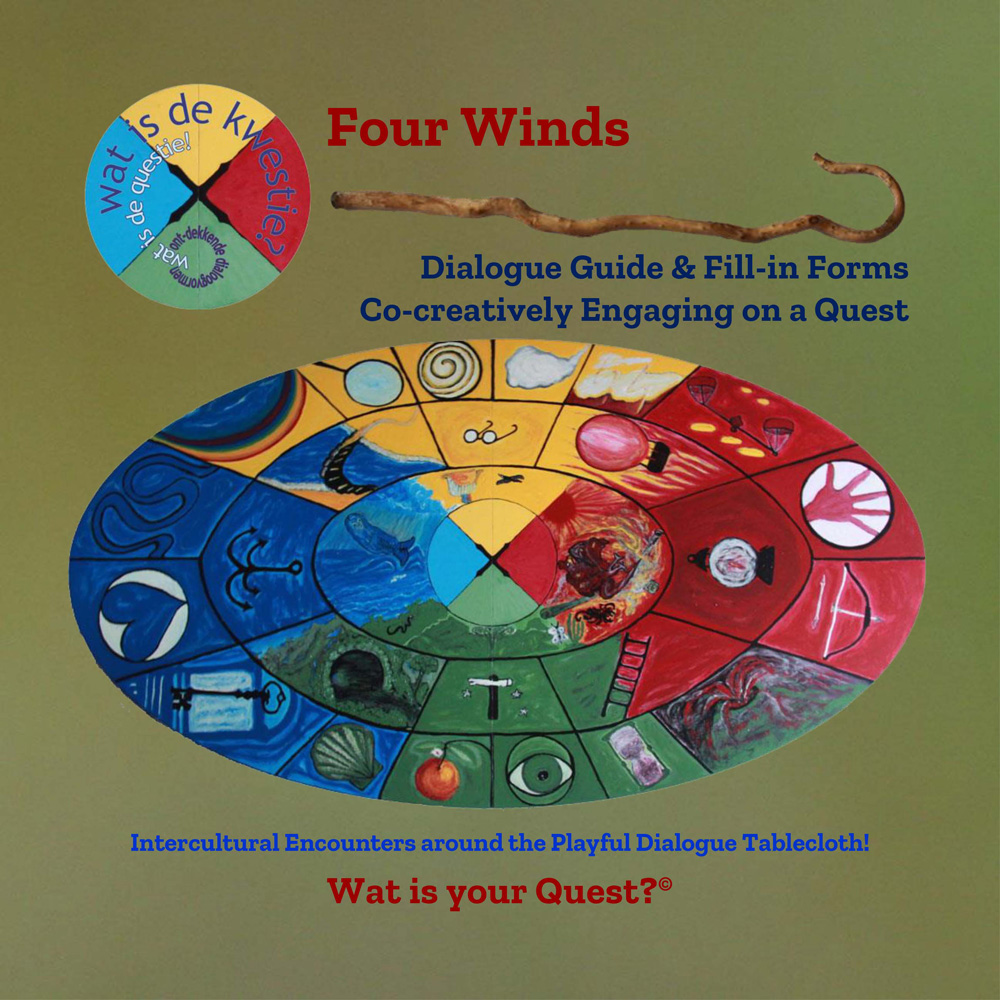
The ‘Four Winds’ take you on a journey of discovery in four rounds, around the colourful dialogue tablecloth, full of symbolism. These symbols enrich your conversation with mythological wisdom and intercultural perspectives.
The playful materials help to visualise what is at stake on a quest: “What does your issue look like as a journey? What mythical creatures and animals will you meet along the way? What other questions become relevant when you look at the issue from others perspectives?” A multidimensional approach is enhanced by means of philosophical and intercultural sayings on the playing cards. In the fourth and final circle, the four basic colours green, blue, yellow, and red in the
creative excersise in-between the dialogue
four quadrants, symbolise the reaping of concluding visions from the conversations in the four rounds. With a Quintessence drop, you unroll the dialogue as a journey across the dialogue tablecloth: this symbolic act helps to imagine the essence of the exploration of the issue at stake and to express this in a poetic form
Dialogue as an art: listening, asking questions and answering authentically
Playing Guide Four Winds
Through a dialogue guide, you explore a challenging issue as group of friends, family or team, or, each individual can investigate their own question with the group.
Depending on the size of the group (2 to 8 players), the game will be completed in two hours, half a day or a full day.
In four rounds of dialogue ― visible as the four circles on the dialogue tablecloth ― participants move from the outside in, to the inner circle in which the Four Winds are depicted.
Images tell a story
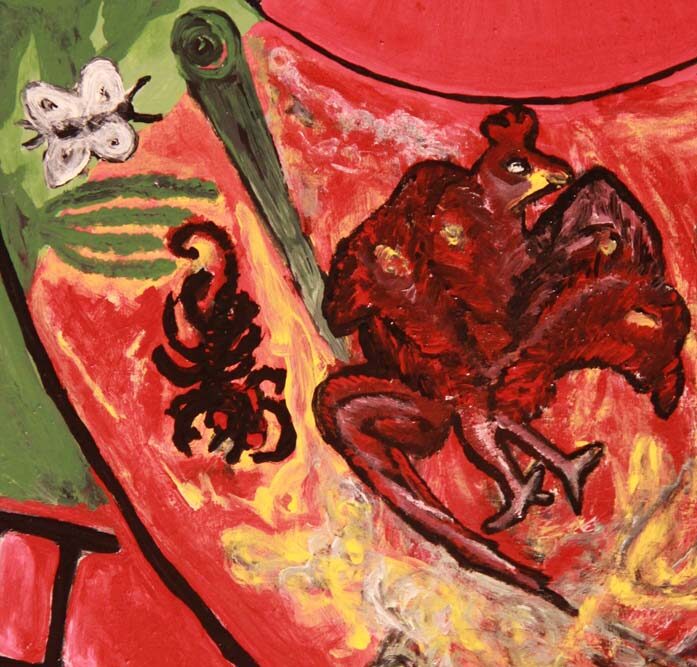
Butterfly, Scorpion, Fenix
The colours on the dialogue table refer to the four elements earth, water, air and fire. These are connected in the game with a basic symbol, which opens a space for encounter, such as the eye as a ‘mirror of the soul’.
“I dreamed I was a butterfly… or am I a butterfly dreaming of being a human?”
Zhuang Zi (369-286 BCE)
The four rounds
Symbolic objects to enricht the dialogue
In the first round, the images (and rich objects) in the outer circle of the dialogue tablecloth invite participants to imagine the theme they want to investigate.
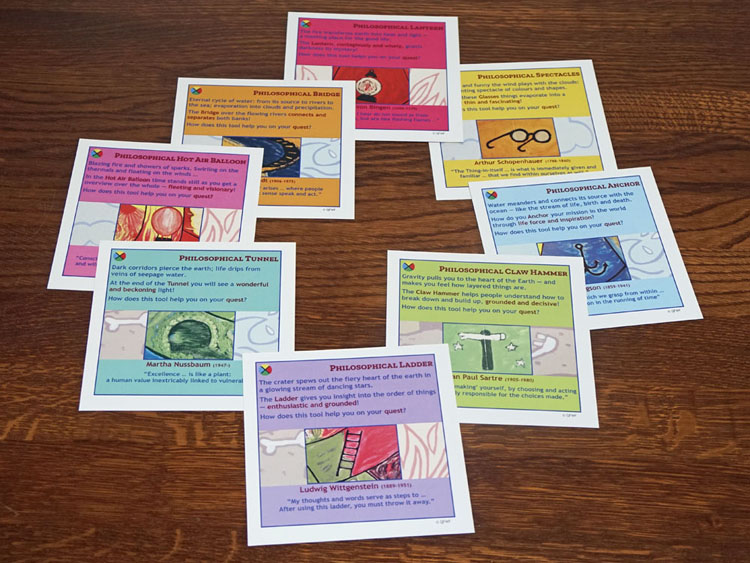
In the second round you are given one of the eight symbols for philosophical tools with intercultural perspectives: these represent qualities for the art of living to be able to deal with the issue more wisely.
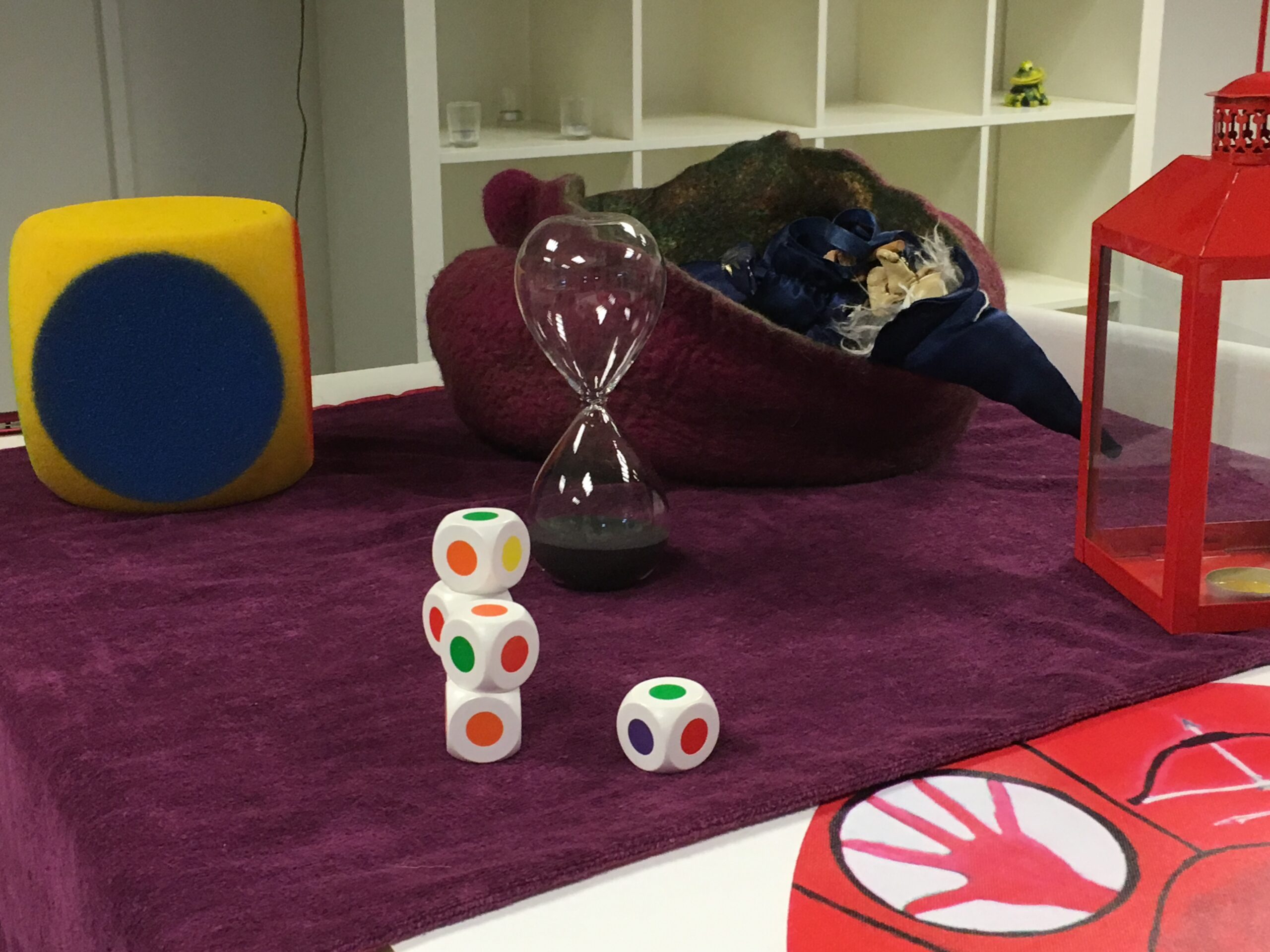
In the third round, you roll the coloured dice and see which creature or animal you encounter in the mythical landscape on the dialogue tablecloth. How could the virtues and vices, as well as divine qualities that they embody, help you to realise the good life?
Playing materials for a dialogue workshop
For the fourth round, the wind rose in the four elementary colours on the dialogue tablecloth visualizes the four cardinal directions, from which the harvest of the game might help to get the issue in the right direction. Participants describe their harvest from the dialogue on the Game Fill-in form as a quatrain.
Cards with intercultural perspectives, rich objects around the playful dialogue table.
Duration: 2 hours to one (half) day in a small group up to 8 players.
Dialogue Guide: explaining the game and the symbols
Playing Field:
1 Dialogue table cloth
Game attributes:
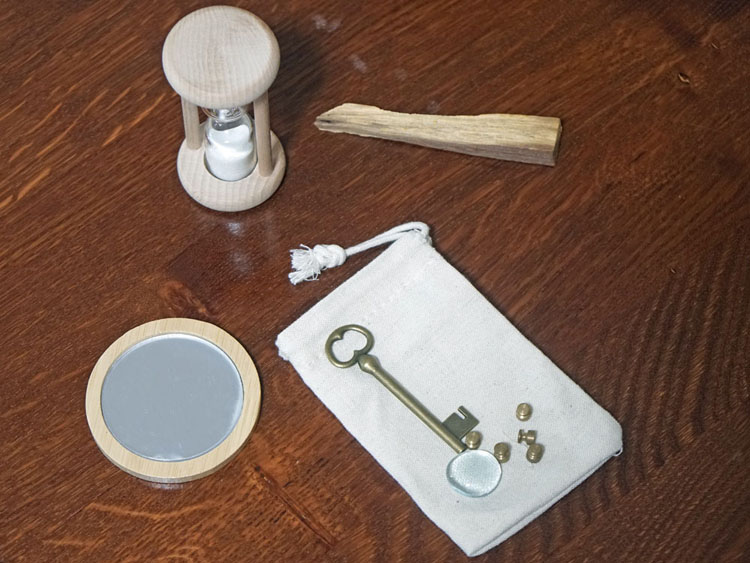
1 mirror;
1 key;
1 hourglass as rich object on the Dialogue table;
Small weights;
1 quintessence marble;
1 small talking stick;
1 hour glass
Dialogue Tablecloth with symbolic objects
Playing Cards:
8 Philosophical Tools with Western perspectives
8 Philosophical Tools with intercultural perspectives
Fill-in forms:
Double sided with instructions for writing a quatrain
The Colourful Tablecloth with the four rounds is to purchase for € 10.
Costs: You become a ‘QfWf-friend’ through a donation and get a welcoming gift of the book Amor Fati! If possible € 45,= a year on IBAN NL14TRIO0777827654 of the Quest for Wisdom foundation in Weesp.
The QfWf is happy with every donation given from a good heart!
Playfulness creates space for establishing meaningful connections between people, which fosters encounters that both entertain, educate and stimulate the participants: by letting go of our compulsion to let norms, codes and protocolles decide for us. This is an escape from our human responsibility and the possibility to cocreate a new interplay: the human condition of natality, as Hannah Arendt calls the new beginning that may arise in in-between spaces…. Feeling free to explore different perspectives together and to agree on appropriate rules for what is at stake, is what makes us human.
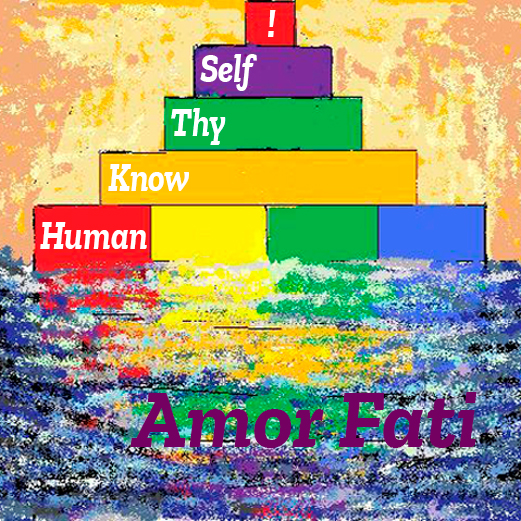
The Quest for Wisdom foundation has created the Wheel of the Intercultural Art of Living, on which the book and game Amor Fati elaborates, enhancing Global Citizenship. Amor Fati is an intercultural redesign of the board game Know your self! The book explains the board game as well as the philosophy of the Wheel of the intercultural art of living. Lecturer Michiel de Ronde says about this book:
“I see your work as a great reassessment, also revaluation, of the pre-modern world orientation. All those profound insights and life-creating practices that were often worshipped or cursed through hierarchical dominance, you present within a depth perspective of an endless horizontal mythic-human field, through which the world can become a home for all beings and people can meet on the basis of dialogue and appreciation.”
With the Quest for Wisdom Soul Circle the Amor Fati game and book have been performed by means of Arts Dialogues in nine gatherings from the summer 2025 till the summer 2026: Read the red thread through these gatherings as Playing Wisdom with Amor Fati Arts Dialogues for the Cosmopolis!
NL/EN, 2024, ISBN 978 90 441 3970 9
Also the bilingual Dialogue Tables Four Winds (De Vier Winden) is developed to enhance an open cosmopolitan culture as global citizens — the intercultural enriched version of What is at stake? What is your Quest?
The Adinkra-game consists of a set of cards with Akan symbols and proverbs, ordered according to the wisdom of the five elements earth, water, air, fire and ether — in a way that the Ghanaian elemental wisdom might be compared to European visions on the natural elements. In this way the game invites you to excercise intercultural communication!
There are more World Games and educative materials (to be) developed, in which intercultural perspectives are playfully and dialogically incorporated.
Workshops and Masterclasses around the themes of the QfWf-Archive dialogue and play forms are still to be requested, though not for sale anymore as board-game or Dialogue Table:
QfWf-Archive — Mythical-Philosophical Boardgames
Know yourself — the mythical-philosophical boardgame
One hundred percent of the money raised by the sale of all of the products will be used in realising our upcoming QfWf educational projects, all of which are non-profit and run by volunteers.
“Every culture passes on its wisdom to future generations to grow as a person on an inward journey to the quintessence, that connects all corners of the world. Thereby we flourish as a community, celebrating life in the cosmopolis “
In a tilting world order the QfWf aims to contribute towards a culture of openness and pluriformity by tapping into one’s own and shared historical roots. Using Art Dialogues to revitalize wisdom traditions worldwide and liberate ourselves from groupthink!
The Wheel of the Intercultural Art of Living has been created to realize this mission. By the spinning of the Wheel around a yearly theme the three Quests flow together on our platform DeGuldenSnede – to be followed on these websites with QfWf-Programmes:
Wisdom Web
The Wisdom Web is both an archive and a forum for cultural exchange to promote wisdom connecting people and their cultures, something that our current times call for.
At the Wisdom Web, wisdom from all corners of the world is collected and presented in its own unique and symbolic way through the Wheel of intercultural art of living.
The Wisdom Web was launched in 2017 under the auspices of the Quest for Wisdom Foundation (QfWf).
Just as the principle of the Golden Ratio guides natural and cultural development — the growth of organisms like shells and plants, as well as beauty in music, poetry, and the visual arts — the QfWf aims to be a catalyst for connecting people with their cultural heritage, in harmony with natural wisdom and intercultural life skills as an expanding circle of global citizens.
The Golden Ratio works with annual themes. In 2026, this is “Intercultural Rituals for Global Citizenship.”
is an intercultural storytelling programme: narratively and artistically designed animal wisdom from all corners of the world has been collected and presented through the Intercultural Wheel of Animal Wisdom.
Animals in their element ― in fables, art, fairy tales and myths ― inspire an elemental art of living!
The QfWf Animal Wisdom programme aims to collect animal wisdom from various cultures and develop them into engaging educational material. For the purpose of raising ecological as well as intercultural awareness on transcultural connections and symbolism.
We’d love to receive your donation via a bank transfer:
bankrekening IBAN: NL14TRIO0777827654
Thanks for your gift that helps to realize the goals of the Quest for wisdom foundation (QfWf)!
You become a QfWf-friend by donating yearly
We hope for a donation of € 45,= per year – though we are happy with the amount you are able to give!
In addition in helping to realize the intercultural QfWf-programmes, contributing to our aim of Global Citizenship, by donating € 45,= per year as a QfWf friend you get:
the (e)book about the annual QfWf-programme, such as Amor Fati in 2025 and Amor Mundi in 2024;
Masks and the wisdom in live encounters: the strange other — within yourself
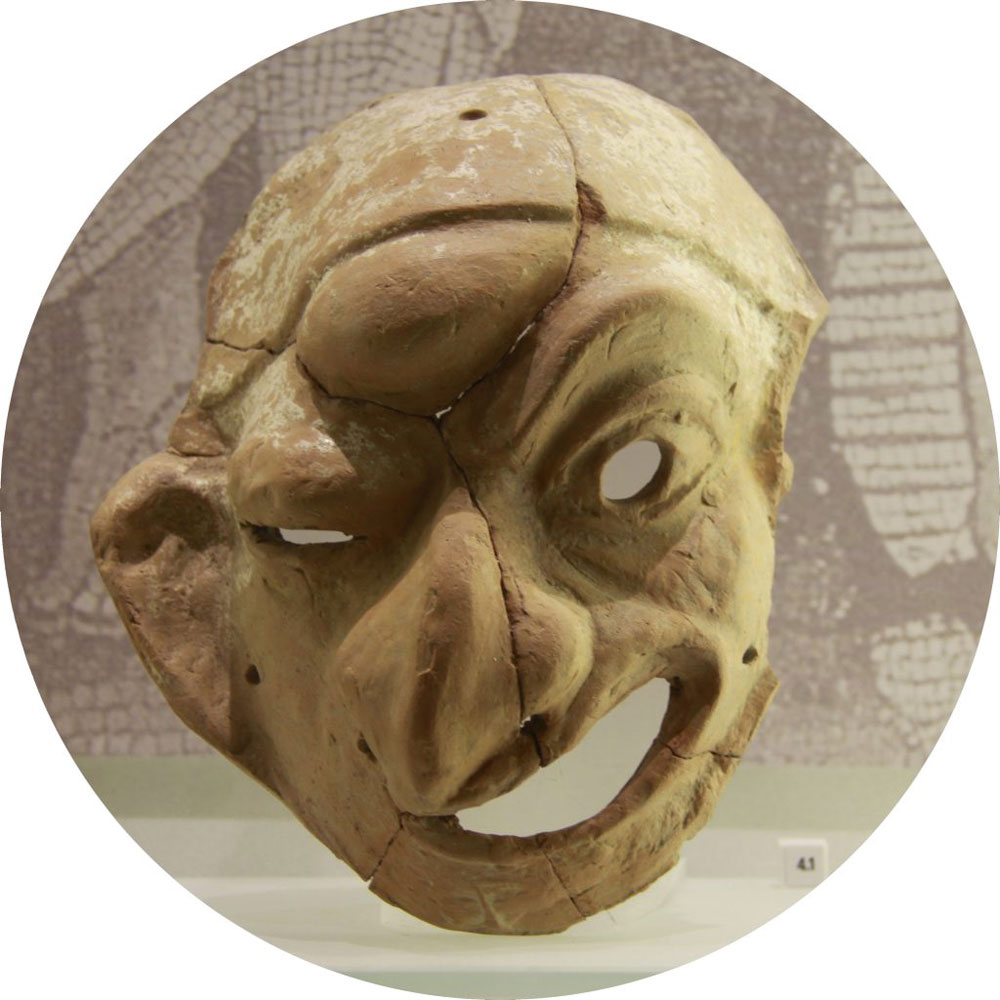
Jester (Museo Nazionale Archeologico di Taranto, Italy) — photo by Joke Koppius
With the masquerade game you explore the social masks that we all wear and the art of meeting each other in a small group. The game lets you play with kingly wisdom and foolish tricks! It invites you to see the interplay between people as a masquerade and to meet the strange other (in yourself) and thereby unmask yourself and others.
Playing with masks teaches one to find a good balance between identification with functional role(s) and total detachment to your own form of social engagement.
Playing with social masks and tapping into your own jester and king to wisdom
The Masquerade Game provides an introduction to the Hero Game: play yourself!
Duration: at least one half day, for 3 to 6 players.
A workshop ‘demasqué’, also available an in-company program, with a multitude of the game material for groups of teams of up to 24 people: to strengthen relational qualities and developmental processes by giving attention to nasty encounters, bad feelings in collaboration and confrontations in work contexts.
Playing Materials
Part of Masquerade Game: Meeting Strange Others!
Box containing:
Playing field:
1 Nasty Encounters
Play Attributes:
1 Hourglass (of about 3 minutes);
1 six Colour Dice;
6 Coloured Pencils;
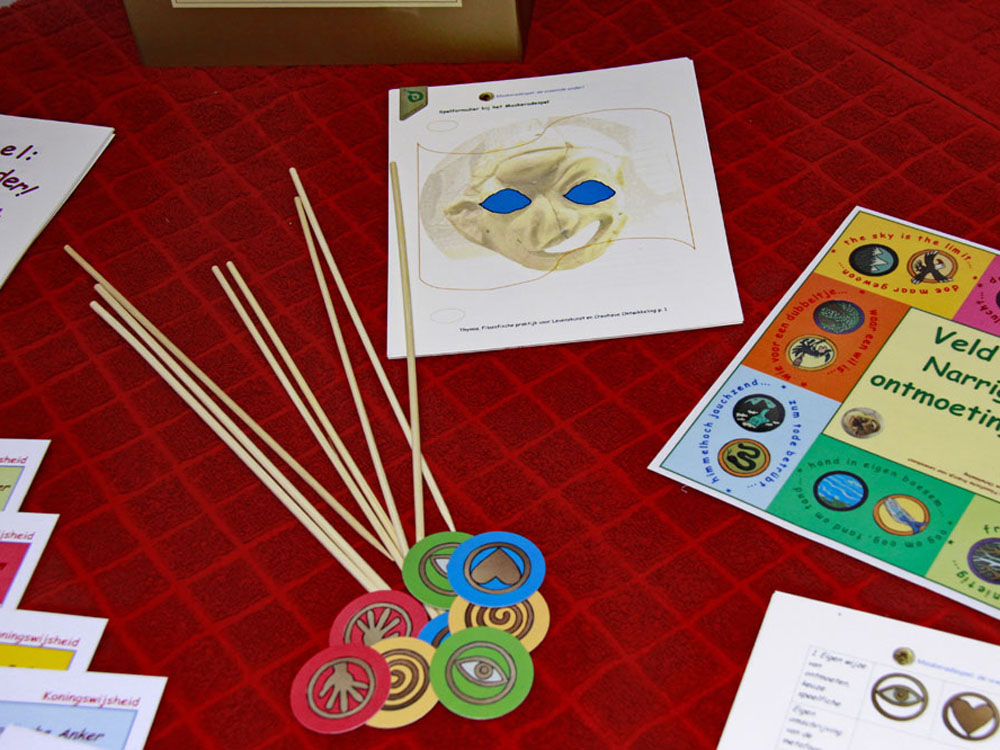
8 mask holders
Playing Cards:
8 Nasty creaturers;
8 Royal Wisdom
Playing tokens:
8 Symbols of Encountering
Working Materials:
1 Instruction Guide with
8 Fill-in form for the exercises in the game;
8 Format for making the mask;
Passion as wisdom on elementary paths of research in order to develop the good (working) life
The Compassion Game appeals to the passions of players to align their course in life and career with their own inner compass. The game assignments are aimed at imagining and articulating the meaning of the good life in relation to tragedy. A playful introduction to research traditions from the perspective of philosophical counseling.
Using the symbolism of the four elements and mythological stories, you are invited to explore a personal fascination hand in hand with a theme from your own professional practice.
Compassion Game: the good life!
In the 6th century BCE natural philosophers debated which of the four elements contains the origin of life.
An investigative approach to this question marks the transition from a magical-mythical experience of the world to a rational worldview.
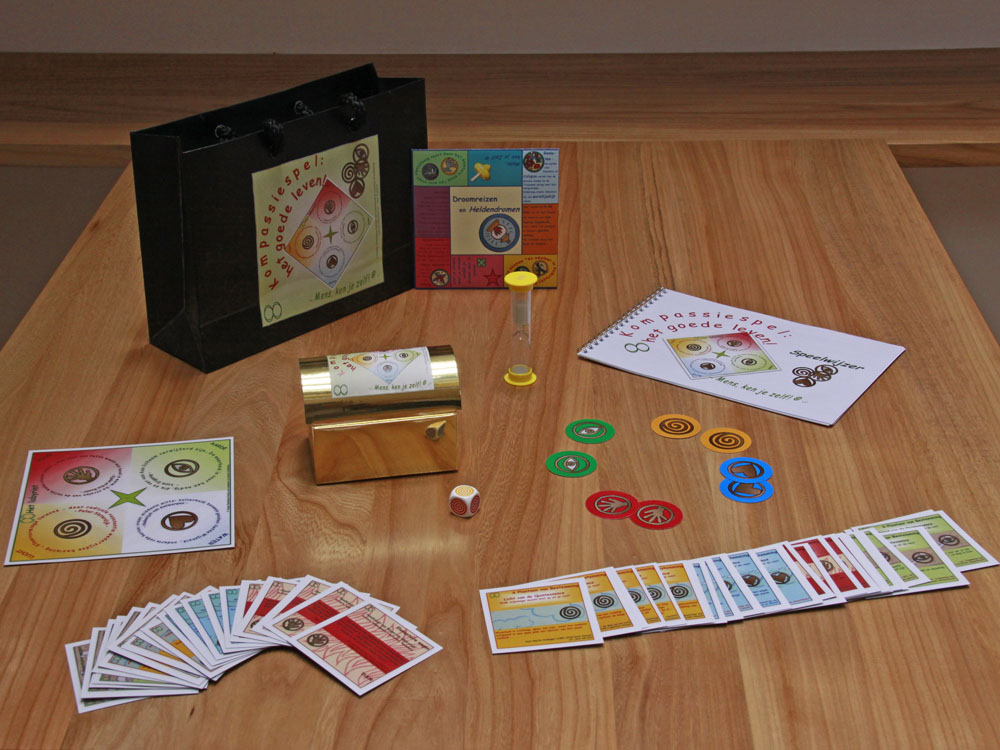
ISBN: 978-94-92127-05-1 — Kompassiespel: het goede leven!
The Compassion Game for developing the good (working) life provides a playful introduction to research paradigms and to Levensvisiespel: Visualize your inner compass!
Duration: two half-days, for 3 to 6 players.
Playing materials
Box contains:
Playing Field:
1 the Labyrinth
Playing Attributes:
1 six Colour Dice;
1 Hourglass (of about 10- 15 minutes)
1 CD Dream travelling and Heroic Dreams (Droomreizen en Heldendromen) with 22 songs
Playing Cards and Tokens:
4*5 Cards with Elementary Ways;
4*6 Cards with Places of Destination;
2*4 Tokens with Symbols of Power
Working Materials:
1 Instruction Guide with
8 Fill-in form for the exercises in the game
ADM is the research variant of the board game Know Yourself, the Compassion Game, and has contributed to the development of the Body of Knowledge and Skills of the master’s degree program in counselling at Rotterdam University of Applied Sciences and at Arnhem and Nijmegen Universities of Applied Sciences.
By playing the game with the involvement of teachers, the symbolism of the game has co-creatively led to the development of concepts of research qualities; such as the dynamic interplay between the ‘power symbols’ of the eye, the heart, the spiral and the hand, which has been interpreted as the methodical interplay of different voices inside oneself: mythos, pathos, logos and ethos.
This methodology has been developed into the Art Dialogue Methods (ADM), a developmental oriented approach in change processes and action research. A forthcoming textbook will be published about ADM, and there have been articles published in professional magazines (in NL): een artikelen reeks ― Begeleidingskundig-Handelingsonderzoek-MBK
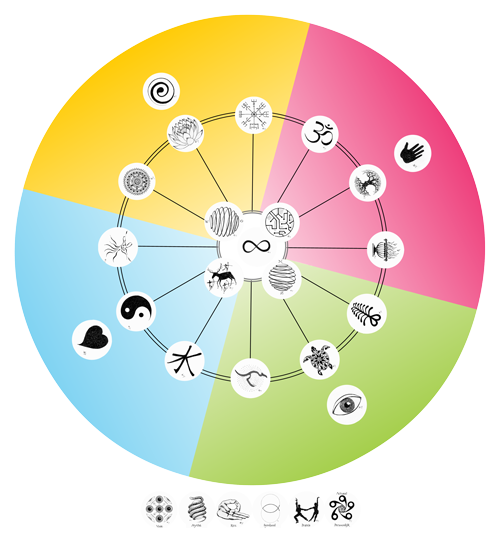
The Wheel of Intercultural Art of Living visualizes the philosophy and mission of the QfWf
Just as a wheel can turn thanks to the hub, the intercultural art of living revolves around open spaces connecting people and their cultures from a living center — inter-esse.
The Wheel visualizes:
Colours/medium – representing the five natural elements (earth, water, air, fire and ether)
One focus — the circle with an edge and a centre that represents the dynamics of the wheel two-dimensionally with a centripetal direction from periphery to centre and vice versa as a centrifugal movement —
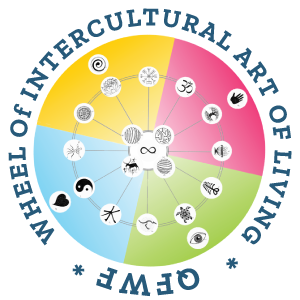
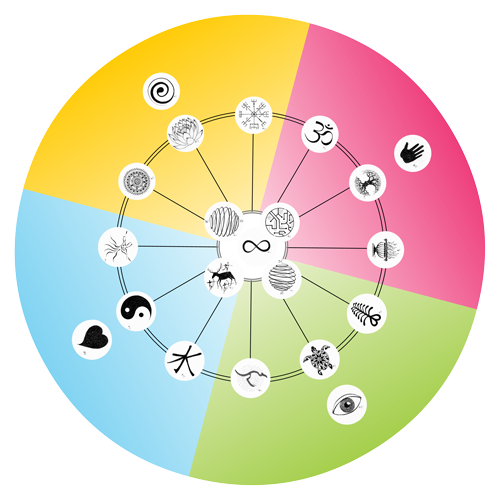
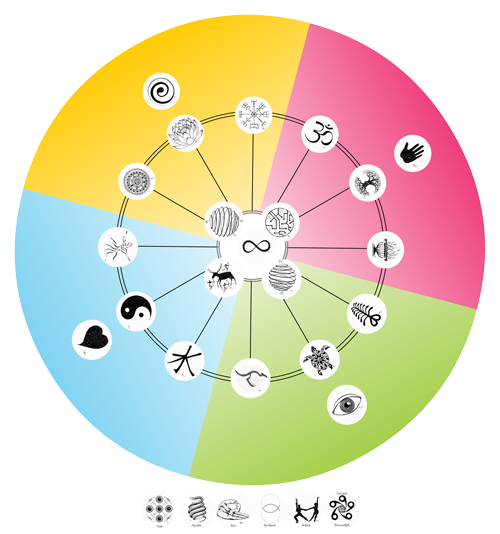
The wheel consists of sixteen spokes representing wisdom traditions
Under the Wheel the six pictograms as the dimensions
The sixteen spokes use the pictograms drawn by Louis Van Marissing to refer to wisdom traditions from East and West, North and South. The Wheel vizualizes these different approaches to wisdom, acknowledging its many different forms from various cultural traditions: wisdom as quest and not as a ‘canon’ of dogmas in a holy book.
These religious and spiritual roads, philosophical and mythological directions are expressed both verbally as well as artistic. The different forms of expressions are typified by the six dimensions, also indicated by pictograms under the Wheel: visions, myths, rituals, symbols, praxis (arts, meditation and crafts), actuality and personal experience.
The QfWf-Quests flow together for the development of the Annual Theme, following the rhythm of Seasonal Gatherings and the yearly Meeting Day (Quest 3). It works like a cross-pollination of collected wisdom from all corners of the world (Quest 1) through dialogical and intercultural educational play- and art-forms, and storytelling (Quest 2) — texts, images, music, poems, stories, …. Since 2024, these have been presented around an annually changing theme on global citizenship at the QfWf platform The Golden Ratio.
See theQfWf-Brochurewith the developed game & dialogue, story, and art forms.
Symbolic bridges between cultures
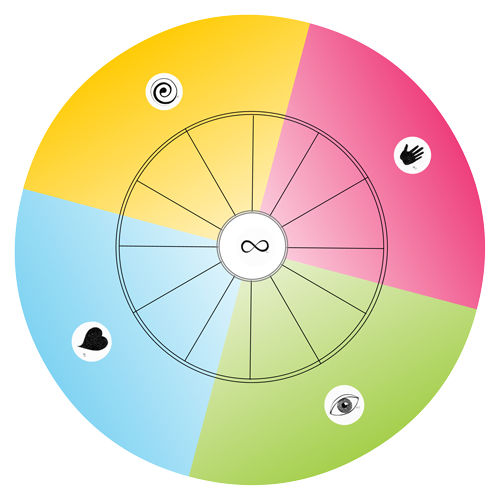
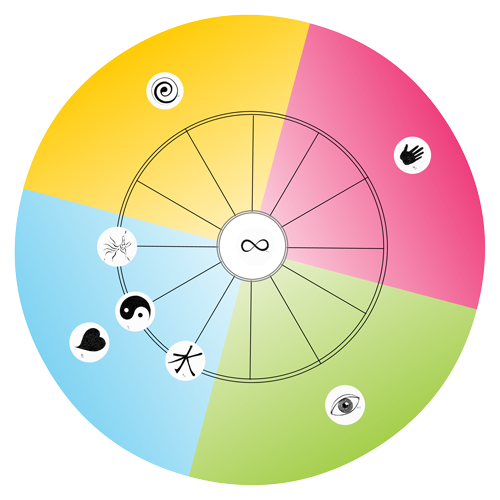
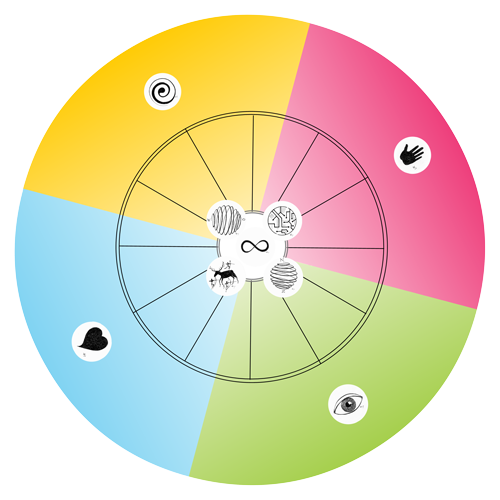
The wheel visualises intercultural bridges through the symbolism of the five elements: these are depicted as five elementary fields with their own pictogram (eye, heart, spiral, hand, lemniscate) symbolising natural wisdom that makes us human, and, within them, the spokes of sixteen (inter)cultural paths to wisdom.
The QfWf dissociates itself from racial and ethnocentric provisions by presenting the language play of the five elements emphatically as a symbolic arrangement of the Wheel. Within this, sixteen wisdom paths are assigned in an associative way, without wanting to interpret the (folk) nature of cultures, tribes and peoples. The focus of the QfWf is to develop intercultural exchange and connections on the basis of a symbolism that occurs as a mythical and artistic language in almost all cultures. In this way, the QfWf remains outside philosophical, theological and political debates about the appreciation of cultures. Whereas the intercultural symbolic language touches the soul and thereby it makes the old wisdom from all corners of the world alive for actual contexts.
Symbolism of the five elements
In almost all cultures, the natural elements in mythical, philosophical and religious stories play a basic role. That is why the five elements in the Wheel form pillars for building inter- and transcultural connections. Compared to the Western natural philosophical debate, these concepts are given a dynamic and symbolic meaning in the three Quests.
As can be heard in original and heroic stories from almost all cultures, the process of separating and reconnecting the elements symbolizes an alchemy as a process of creation. A natural order arises out of an original chaos, emptiness or by a divine creation. Also, in all wisdom traditions, paths to a good life have been developed – aimed at connection from within – which are called differently: ‘salvation’, ‘enlightenment’, ‘moksha’, ‘compassion’, ‘humanity’, ‘walhalla’, ‘the eternal hunting ground’, ‘The kingdom of God’, ‘Heaven’, … This ‘mystery of scuaring the circle’ is expressed by the archetypal form of the Wheel and its symbolic depiction of the intercultural art of living:
The four elementary fields – earth, water, air and fire – symbolise a movement towards the periphery, the four corners of the world, where the value of diversity becomes visible. The movement towards the centre, through three groups of (inter)cultural paths on the elemental fields of earth, water, air and fire, focuses on the coherence between cultures and the development of transcultural connections.
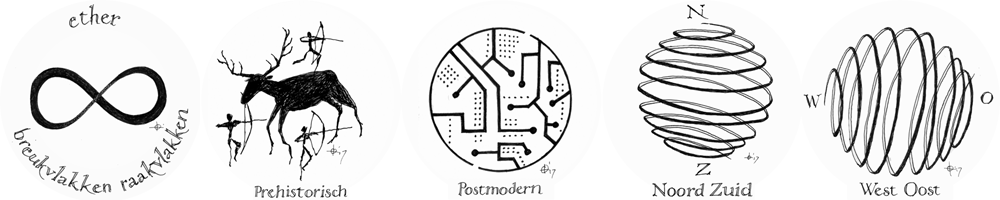
The fifth elementary field – ether – symbolizes in the centre the place of connection from within (the place that is not a place, the unity of opposites, the philosophia perrenis). Visualized with four pictograms are encounters between cultures 3 through history and time, manifesting themselves as interfaces, intersections and rifts in history and between eras.
Rotating around the core, the Rad visualizes the development of
intercultural art of living from the three layers:
Layer 1: the five elementary fields of wisdom
Layer 2: the sixteen (inter)cultural paths to wisdom
Layer 3: the six dimensions
From the perspective of the Wheel, religious, scientific, literary, artisanal, philosophical and artistic expressions appear equally as symbolic forms and building blocks for intercultural connections. The diversity of cultural expressions and visions on the good life are symbolically arranged as an intercultural art of living by means of the Wheel:
* by symbolically characterizing the five ‘elementary’ fields
* by linking expressions of wisdom and (inter)cultural wisdom paths to these five fields
* by visualizing an ‘in-between’ a space for dialogue and exchange based on cultural forms of wisdom.
Exchange, development and cross-fertilization take place along five elementary fields by rearranging wisdom from religious and cultural traditions according to their cultural- historical origins on the one hand, and, on the other hand, according to intercultural and transcultural forms of wisdom as seen from the elementary symbolism of the Wheel. For example, the Tree of life is a transcultural symbol that expresses both a kinship between cultures as well as a concrete form of a particular expression of a Tree of life as recognized within a specific culture.
The five elementary fields of wisdom
The wheel with the five elementary fields
The symbolism of the five elements generates a bridge language between cultures with the aim of further developing an intercultural art of living.
Just as in the poetry of mystics as well as in mythical stories in all corners of the world the symbolism of the eye and the earth, of the heart and the water of life, of the spiral and (inner) space, of the hand and the (inner) fire, and of the lemniscate and the field of ether (akasha) serve as symbolic expressions of wisdom:
The green quadrant with the eye is associatively connected to the earth and unlocks a symbolism around eye power, the seeing of the (strange) other, earthly and grounded;
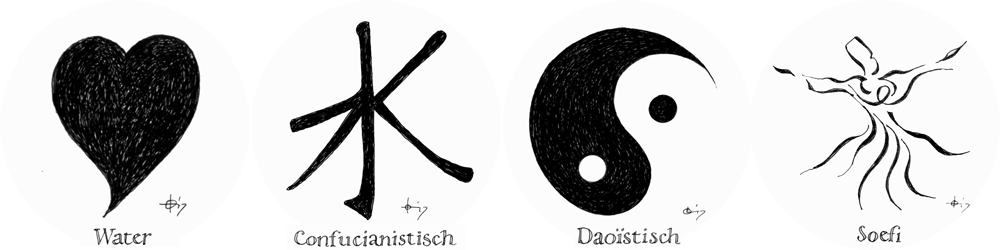
The blue quadrant with the heart is associated with water and opens up a symbolism around heart power, spontaneous expression including flowing and counter-flowing movements;
The yellow quadrant with the spiral is associated with the air and opens up a symbolism around light and darkness and the rhythm of breathing;
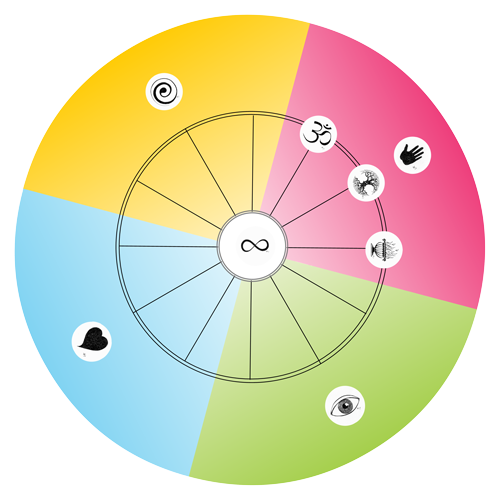
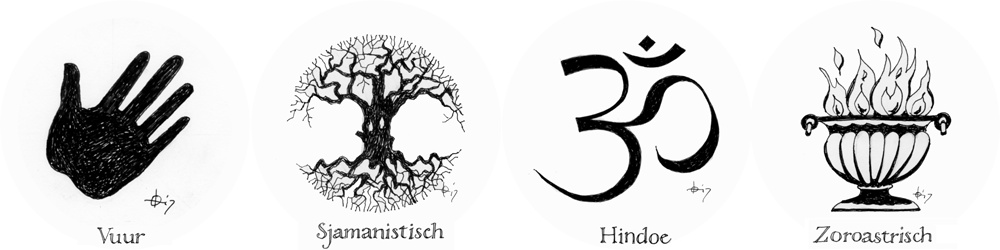
The red quadrant with the hand is associated with the fire and opens up a symbolism around fire (offerings) and the power of transformation;
The white circle around the centre with the lemniscate is associated with ether and opens up a symbolism around an eternal movement of cultural-historical appearances and links ether as the fleeting cosmic element.
The five fields have been characterized as forms of the art of living with the help of symbolic icons:
Earth – the eye – a meaningful field of natural connection and physical, grounded presence;
Water – the heart – a symbolic field giving meaning to lovingly meandering together with the natural currents and counter currents;
Air – the head (spiral) – a meaningful field of breathing, coordination inside and outside, insight and being attentive;
Fire – the hand – a meaningful field of sacrifice, transformation and acting change;
Ether – the quintessence (lemniscate) – a meaningful field of the interplay of the four elements, of alchemy and encounters, connections and fault lines.
Wisdom traditions and wisdom are given a place on the elementary fields of wisdom and the sixteen (inter)cultural wisdom paths appear as the spokes of the Wheel.
Wisdom traditions – from Buddhism to Nordic mythology, from Christian rituals to Indian myths – can be organized according to their cultural-historical origins as well as a source for developing an intercultural art of living in the context of globalizing society.
The intercultural art of living is growing from its cultural-historical roots and will be nourished from (inter)cultural studies by which wisdom traditions can be kept alive in a global context.
Both personal expressions and stories handed down as contextually embedded wisdoms, as well as practical and art-based forms of the art of living, are given a symbolic rearrangement by means of the Wheel: as inspirational examples of ‘elementary’ – earthly, meandering, airy, fiery, ethereal – expressions and forms on how to live life well.
The symbols in the Wheel (namely the eye, the heart, the spiral, the hand and the lemniscate) therefore represent, both on a collective and personal level, the elementary existential qualities for the development of a basic attitude of openness and interest, around a pivot of love and wisdom, the quintessence, the loving willingness to connect, meet and open up for intercultural dialogue.
The development of intercultural art of living through the Wheel
In the philosophy of the Wheel, these elementary existential qualities – of the open heart, the embodied eye, the hand of co-creation, the attentive path spiraling in and out, and the lemniscate of living encounters and the infinite creation of meaning – form the indispensable pivotal points for the development of an intercultural art of living and transcultural forms of living the good life. The QfWf stimulates this development with educational and artistic materials in order to stimulate an open cosmopolitan society. By highlighting both the cultural-historical roots of wisdom and to keep the natural wisdom alive between people in groups and communities as a (collective) art of living. Therefore, the Wheel points to a culturally connecting symbolic language of the soul: with ‘elementary’ symbolism of the — earthly, meandering, airy, fiery, ethereal — good life
Cultural diversity is visible on the periphery of the Wheel. Towards the centre the elementary fields and intercultural bars (spokes) touch the hub (pivotal point). The hub symbolizes a transcultural dimension that transcends cultural determinants. Through the colourful differences there is an elementary focus on what connects people: by moving beyond the opposites on the surface level of (collective) opinions and interests to the deep dimension of humanity and loving wisdom (the pivot) in the centre; where the opposites coincide, the quintessence.
By means of ‘bricolage’ (the way an engineer (bricoleur) uses just the available tools and materials to make structures) with insights and forms of praxis of multiple cultures one can develop a global society for the purpose of becoming human (becoming who you are) and developing local communities with a cosmopolitan spirit.
For example, with regard to a focus on ‘the right middle’ (Aristotle) according to the practical wisdom (‘phronèsis’) of the community, there is a relationship between Greek classical virtue ethics with insights from Ubuntu and from Confucianism and values of ‘communitas’.
A Golden Section of Wisdom
The wheel with the five elementary fields and sixteen spokes, depicting intercultural roads
The Wheel represents therefore above all a performative philosophy: a vision that emerges in co-creation through the language of the arts: a sym-philosophizing to be developed in intercultural circles of concern.
In the Wheel, the wisdom traditions are both contextually embedded according to their cultural-historical origins, depicted as sixteen spokes as examples of paths and sources for intercultural wisdom. This ambiguous positioning arises from the symbolical bridges, the symbolic language of the five elements, providing a twofold orientation: both towards philosophical unity and transcultural forms of life, as well as towards the periphery of cultural diversity. The inter- and transcultural dynamics at the corners of the elementary fields is symbolically characterized with pictograms.
There are two levels of developing wisdom: At the collective level of wisdom traditions:
earthly paths of wisdoms give expression to a grounded quality and embodied see,
meandering roads of wisdom are expressive of a heart-quality: coagulating and liquefying the status quo,
wisdom of the air and breathing that expresses the rhythmically inwards and outwards spiralling connection of natural being with the macrocosm,
fiery ways with wisdoms that give expression to community ethos and co-creating (hands on) qualities,
ethereal pathways expressing an eternal lemniscate movement of finding meaning: volatilizing and deconstructing and then materializing and socially
constructing again;
on the individual level of the personal art of living:
In a globalising society, people can draw on various wisdom traditions without the need to join as an adept of a particular tradition. Wisdom paths in all corners of the world give direction to personal growth as well as the collective forms of wisdom, like rituals and storytelling. The Wheel is meant as a compass to be able to orientate oneself in the diversity of directions. The five elementary fields open up intercultural fields of finding meaning through exploring various cultural wisdom traditions and transcultural values.
The Wheel provides symbolic signposts for personal growth through the development of elementary existential qualities of natural and intercultural wisdom:
eye-power through the embodied seeing and from imagination (mythos)
the open heart, depicting compassion and enthusiasm (compassion and pathos)
the spiral, depicting resonance and tuning in to the rhythm of breathing, connecting inside with outside (logos)
the hand, depicting action and starting a change with movement from within and hands-on (ethos and cocreation)
the lemniscates, depicting the space between ‘frames’ and the infinite process of giving meaning and meeting ‘the other’ (quintessence).
The sixteen (inter)cultural paths to wisdom are grouped per elementary field.
They are represented with their own icon.
The elementary field earth and the (inter)cultural earth roads
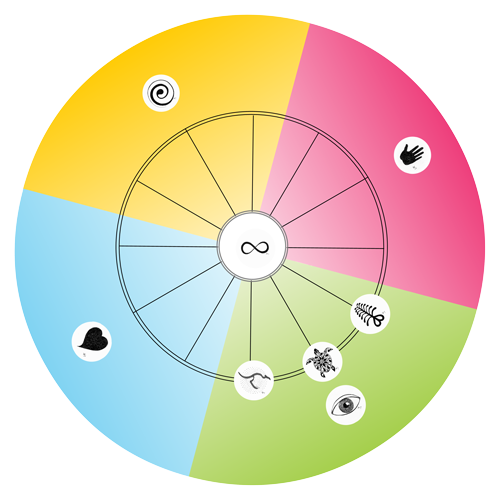
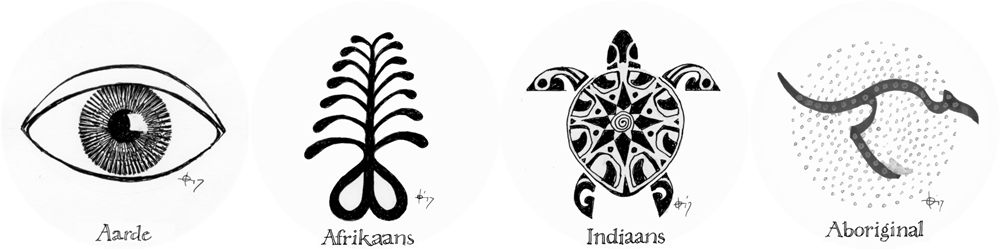
Earth roads in the Wheel
In the elementary field of ‘earth’ three icons have been placed that characterize wisdom paths of tribes and peoples living traditionally from natural contexts. In prehistoric times this ‘pre- modern’ way of life was spread all over the earth. As a result of modernization and colonization, this way of life has been reduced, but is also alive as wisdom from within each human being, and can still be found mainly within: African; Indian; and Aboriginal peoples, Maori and other indigenous peoples of Oceania.
Earth roads
The elementary field of water and the (inter)cultural water roads
Water roads in the Wheel
In the elementary field ‘water’ three icons have been placed that characterize wisdom roads as the natural movement of ‘go with the flow’ as well as the cosmic laws following ways of life (such as astrology). These meandering wisdom roads can still be found as wisdom from within, as well as, for example, be recognized in wisdom traditions such as: Confucian; Dao; and Sufi movements.
water wegen
The elementary field air and the (inter)cultural air roads
Air roads in the Wheel
In the elementary field ‘air’ three icons have been placed that characterize wisdom roads as pathways of insight and breath based on wisdom traditions. This orientation can often be recognized in connection with the symbolism of light and darkness within your soul, as well as in the following perspectives: Buddhist, advaita vedanta; gnosis, mystical and hermetic philosophy; Germanic, Celtic and Nordic mythology.
Air roads
The elementary field of fire and the (inter)cultural fire roads
Fire roads in the Wheel
In the elementary field of ‘fire’ three icons have been placed that characterize religious and spiritual traditions, in which, especially, the meaning of fire and the struggle between good and evil, sacrifices and transformation play an important role. This orientation can be found in each individual in a different way, as well as recognized within cultural wisdom traditions such as: animist-shamanist; Hindu; and monotheistic – zoroastrian, jewish, christian and islamic – directions.
Fire roads
The ether field and the (inter)cultural ether roads
Ether roads in the Wheel
The ‘ether field’ symbolically refers to the fact that the longing for connection and the quest for wisdom – although culturally different and colourfully designed – occur in all human beings and cultures and is nourished by: encounters between cultures, and profile gets through interfaces, intersections and fractures in history and
between eras.
ether roads
The six dimensions
The six dimensions of the Wheel characterize wisdom in many forms on the continuum between theory and practice; multi-layered by means of different medial forms – verbal, musical, visual, ritual, narrative, dancing, … – in which the quest for wisdom is expressed.
By giving space to the diversity of medial expression, the various wisdom traditions can be highlighted in a multifaceted way, showing inter- and subcultural forms, dominant and minority voices.
For example, the elementary field of air (insight) show different paths, such as a variety of forms of ‘Buddhism’ from Zen Buddhism to mindfulness. The diverse wisdom traditions include both visions as well as forms of praxis, a mythology and other narratives and stories, cultural customs and rituals, musical and other artistic expressions of wisdom. The six dimensions of the Wheel are:
visions, philosophy
stories, myths,
rituals, rituality
symbols, symbolism
praxis, arts and crafts
social actuality and/or a personal vision or survival.
With these six dimensions, the Wheel expresses (inter)cultural diversity from the historical roots as well as current practices and expressions of the art of living, shown on the continuum between theory and practice.
The six dimensions
The complete wheel
the five elementary fields,
the sixteen (inter)cultural avenues
the six dimensions
The three layers form the complete Wheel of intercultural art of living.
The complete wheel of intercultural art of living
The Wheel makes visible how the periphery shows cultural diversity and the core presents connections from within, such as the transcultural value of ‘compassion’. The in- between space (between the periphery and the inner core) evokes intercultural dialogues and a cosmopolitan art of living through a Golden Ratio of wisdom traditions, like the budding of a flower which is always through nourishment from cultural roots.
This website uses cookies to improve your experience. We'll assume you're ok with this, but you can opt-out if you wish. Cookie settingsACCEPT
Privacy & Cookies Policy
Privacy Overview
This website uses cookies to improve your experience while you navigate through the website. Out of these cookies, the cookies that are categorized as necessary are stored on your browser as they are essential for the working of basic functionalities of the website. We also use third-party cookies that help us analyze and understand how you use this website. These cookies will be stored in your browser only with your consent. You also have the option to opt-out of these cookies. But opting out of some of these cookies may have an effect on your browsing experience.
Necessary cookies are absolutely essential for the website to function properly. This category only includes cookies that ensures basic functionalities and security features of the website. These cookies do not store any personal information.
Any cookies that may not be particularly necessary for the website to function and is used specifically to collect user personal data via analytics, ads, other embedded contents are termed as non-necessary cookies. It is mandatory to procure user consent prior to running these cookies on your website.

 The Annual Meeting for the QfWf-foundation with a Cultural ANBI status!