
The Wheel of Intercultural Art of Living
The Wheel of Intercultural Art of Living visualizes the philosophy and mission of the QfWf
Just as a wheel can turn thanks to the hub, the intercultural art of living revolves around open spaces connecting people and their cultures from a living center — inter-esse.
The Wheel visualizes:
- Colours/medium – representing the five natural elements (earth, water, air, fire and ether)
- One focus — the circle with an edge and a centre that represents the dynamics of the wheel two-dimensionally with a centripetal direction from periphery to centre and vice versa as a centrifugal movement —
- The wheel consists of sixteen spokes representing wisdom traditions
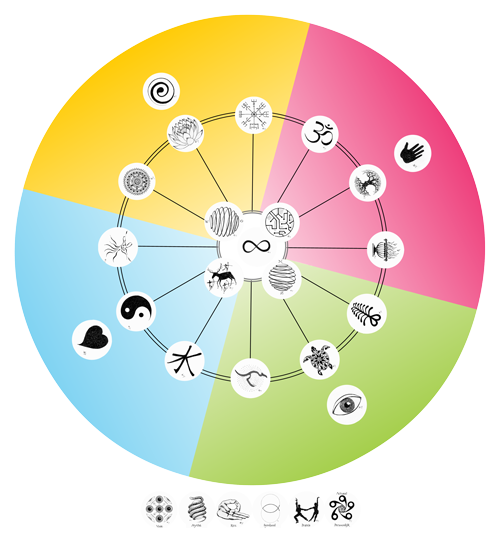
The sixteen spokes use the pictograms drawn by Louis Van Marissing to refer to wisdom traditions from East and West, North and South. The Wheel vizualizes these different approaches to wisdom, acknowledging its many different forms from various cultural traditions: wisdom as quest and not as a ‘canon’ of dogmas in a holy book.
These religious and spiritual roads, philosophical and mythological directions are expressed both verbally as well as artistic. The different forms of expressions are typified by the six dimensions, also indicated by pictograms under the Wheel: visions, myths, rituals, symbols, praxis (arts, meditation and crafts), actuality and personal experience.
The QfWf-Quests flow together for the development of the Annual Theme, following the rhythm of Seasonal Gatherings and the yearly Meeting Day (Quest 3). It works like a cross-pollination of collected wisdom from all corners of the world (Quest 1) through dialogical and intercultural educational play- and art-forms, and storytelling (Quest 2) — texts, images, music, poems, stories, …. Since 2024, these have been presented around an annually changing theme on global citizenship at the QfWf platform The Golden Ratio.
See the QfWf-Brochure with the developed game & dialogue, story, and art forms.
Symbolic bridges between cultures
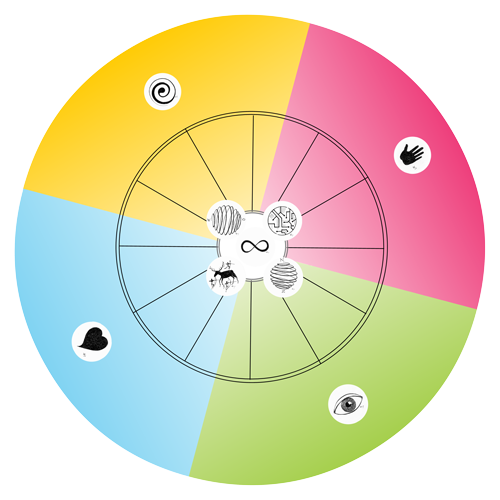
The wheel visualises intercultural bridges through the symbolism of the five elements: these are depicted as five elementary fields with their own pictogram (eye, heart, spiral, hand, lemniscate) symbolising natural wisdom that makes us human, and, within them, the spokes of sixteen (inter)cultural paths to wisdom.
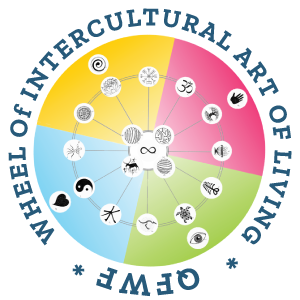 The QfWf dissociates itself from racial and ethnocentric provisions by presenting the language play of the five elements emphatically as a symbolic arrangement of the Wheel. Within this, sixteen wisdom paths are assigned in an associative way, without wanting to interpret the (folk) nature of cultures, tribes and peoples. The focus of the QfWf is to develop intercultural exchange and connections on the basis of a symbolism that occurs as a mythical and artistic language in almost all cultures. In this way, the QfWf remains outside philosophical, theological and political debates about the appreciation of cultures. Whereas the intercultural symbolic language touches the soul and thereby it makes the old wisdom from all corners of the world alive for actual contexts.
Symbolism of the five elements
In almost all cultures, the natural elements in mythical, philosophical and religious stories play a basic role. That is why the five elements in the Wheel form pillars for building inter- and transcultural connections. Compared to the Western natural philosophical debate, these concepts are given a dynamic and symbolic meaning in the three Quests.
As can be heard in original and heroic stories from almost all cultures, the process of separating and reconnecting the elements symbolizes an alchemy as a process of creation. A natural order arises out of an original chaos, emptiness or by a divine creation. Also, in all wisdom traditions, paths to a good life have been developed – aimed at connection from within – which are called differently: ‘salvation’, ‘enlightenment’, ‘moksha’, ‘compassion’, ‘humanity’, ‘walhalla’, ‘the eternal hunting ground’, ‘The kingdom of God’, ‘Heaven’, … This ‘mystery of scuaring the circle’ is expressed by the archetypal form of the Wheel and its symbolic depiction of the intercultural art of living:
- The four elementary fields – earth, water, air and fire – symbolise a movement towards the periphery, the four corners of the world, where the value of diversity becomes visible. The movement towards the centre, through three groups of (inter)cultural paths on the elemental fields of earth, water, air and fire, focuses on the coherence between cultures and the development of transcultural connections.
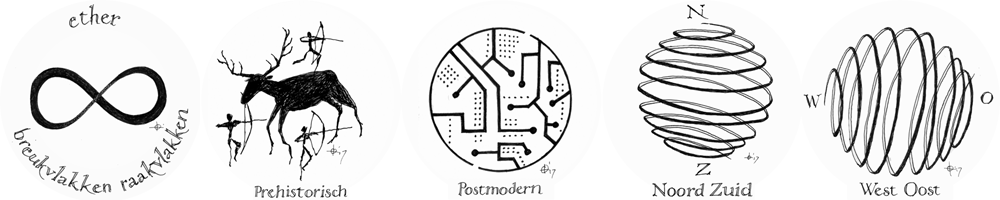
- The fifth elementary field – ether – symbolizes in the centre the place of connection from within (the place that is not a place, the unity of opposites, the philosophia perrenis). Visualized with four pictograms are encounters between cultures 3 through history and time, manifesting themselves as interfaces, intersections and rifts in history and between eras.
Rotating around the core, the Rad visualizes the development of
intercultural art of living from the three layers:
- Layer 1: the five elementary fields of wisdom
- Layer 2: the sixteen (inter)cultural paths to wisdom
- Layer 3: the six dimensions
From the perspective of the Wheel, religious, scientific, literary, artisanal, philosophical and artistic expressions appear equally as symbolic forms and building blocks for intercultural connections. The diversity of cultural expressions and visions on the good life are symbolically arranged as an intercultural art of living by means of the Wheel:
* by symbolically characterizing the five ‘elementary’ fields
* by linking expressions of wisdom and (inter)cultural wisdom paths to these five fields
* by visualizing an ‘in-between’ a space for dialogue and exchange based on cultural forms of wisdom.
Exchange, development and cross-fertilization take place along five elementary fields by rearranging wisdom from religious and cultural traditions according to their cultural- historical origins on the one hand, and, on the other hand, according to intercultural and transcultural forms of wisdom as seen from the elementary symbolism of the Wheel. For example, the Tree of life is a transcultural symbol that expresses both a kinship between cultures as well as a concrete form of a particular expression of a Tree of life as recognized within a specific culture.
The five elementary fields of wisdom
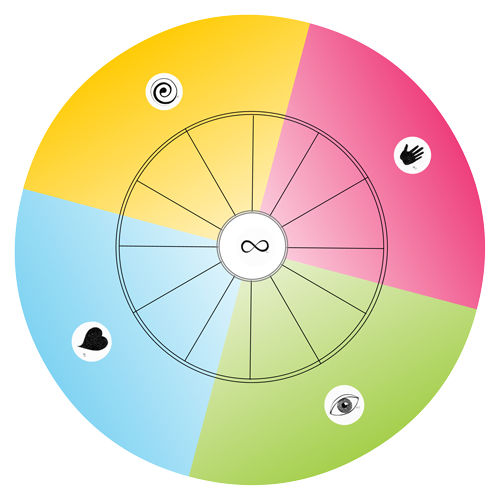
The symbolism of the five elements generates a bridge language between cultures with the aim of further developing an intercultural art of living.
Just as in the poetry of mystics as well as in mythical stories in all corners of the world the symbolism of the eye and the earth, of the heart and the water of life, of the spiral and (inner) space, of the hand and the (inner) fire, and of the lemniscate and the field of ether (akasha) serve as symbolic expressions of wisdom:
- The green quadrant with the eye is associatively connected to the earth and unlocks a symbolism around eye power, the seeing of the (strange) other, earthly and grounded;
- The blue quadrant with the heart is associated with water and opens up a symbolism around heart power, spontaneous expression including flowing and counter-flowing movements;
- The yellow quadrant with the spiral is associated with the air and opens up a symbolism around light and darkness and the rhythm of breathing;
- The red quadrant with the hand is associated with the fire and opens up a symbolism around fire (offerings) and the power of transformation;
- The white circle around the centre with the lemniscate is associated with ether and opens up a symbolism around an eternal movement of cultural-historical appearances and links ether as the fleeting cosmic element.
The five fields have been characterized as forms of the art of living with the help of symbolic icons:
- Earth – the eye – a meaningful field of natural connection and physical, grounded presence;
- Water – the heart – a symbolic field giving meaning to lovingly meandering together with the natural currents and counter currents;
- Air – the head (spiral) – a meaningful field of breathing, coordination inside and outside, insight and being attentive;
- Fire – the hand – a meaningful field of sacrifice, transformation and acting change;
- Ether – the quintessence (lemniscate) – a meaningful field of the interplay of the four elements, of alchemy and encounters, connections and fault lines.
Wisdom traditions and wisdom are given a place on the elementary fields of wisdom and the sixteen (inter)cultural wisdom paths appear as the spokes of the Wheel.
Wisdom traditions – from Buddhism to Nordic mythology, from Christian rituals to Indian myths – can be organized according to their cultural-historical origins as well as a source for developing an intercultural art of living in the context of globalizing society.
The intercultural art of living is growing from its cultural-historical roots and will be nourished from (inter)cultural studies by which wisdom traditions can be kept alive in a global context.
Both personal expressions and stories handed down as contextually embedded wisdoms, as well as practical and art-based forms of the art of living, are given a symbolic rearrangement by means of the Wheel: as inspirational examples of ‘elementary’ – earthly, meandering, airy, fiery, ethereal – expressions and forms on how to live life well.
The symbols in the Wheel (namely the eye, the heart, the spiral, the hand and the lemniscate) therefore represent, both on a collective and personal level, the elementary existential qualities for the development of a basic attitude of openness and interest, around a pivot of love and wisdom, the quintessence, the loving willingness to connect, meet and open up for intercultural dialogue.
The development of intercultural art of living through the Wheel
In the philosophy of the Wheel, these elementary existential qualities – of the open heart, the embodied eye, the hand of co-creation, the attentive path spiraling in and out, and the lemniscate of living encounters and the infinite creation of meaning – form the indispensable pivotal points for the development of an intercultural art of living and transcultural forms of living the good life. The QfWf stimulates this development with educational and artistic materials in order to stimulate an open cosmopolitan society. By highlighting both the cultural-historical roots of wisdom and to keep the natural wisdom alive between people in groups and communities as a (collective) art of living. Therefore, the Wheel points to a culturally connecting symbolic language of the soul: with ‘elementary’ symbolism of the — earthly, meandering, airy, fiery, ethereal — good life
Cultural diversity is visible on the periphery of the Wheel. Towards the centre the elementary fields and intercultural bars (spokes) touch the hub (pivotal point). The hub symbolizes a transcultural dimension that transcends cultural determinants. Through the colourful differences there is an elementary focus on what connects people: by moving beyond the opposites on the surface level of (collective) opinions and interests to the deep dimension of humanity and loving wisdom (the pivot) in the centre; where the opposites coincide, the quintessence.
By means of ‘bricolage’ (the way an engineer (bricoleur) uses just the available tools and materials to make structures) with insights and forms of praxis of multiple cultures one can develop a global society for the purpose of becoming human (becoming who you are) and developing local communities with a cosmopolitan spirit.
For example, with regard to a focus on ‘the right middle’ (Aristotle) according to the practical wisdom (‘phronèsis’) of the community, there is a relationship between Greek classical virtue ethics with insights from Ubuntu and from Confucianism and values of ‘communitas’.
A Golden Section of Wisdom
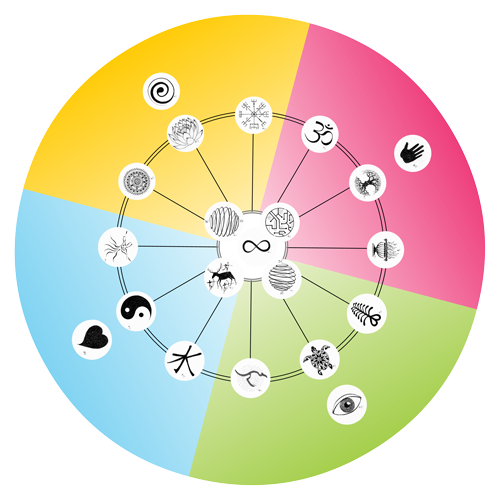
The Wheel represents therefore above all a performative philosophy: a vision that emerges in co-creation through the language of the arts: a sym-philosophizing to be developed in intercultural circles of concern.
In the Wheel, the wisdom traditions are both contextually embedded according to their cultural-historical origins, depicted as sixteen spokes as examples of paths and sources for intercultural wisdom. This ambiguous positioning arises from the symbolical bridges, the symbolic language of the five elements, providing a twofold orientation: both towards philosophical unity and transcultural forms of life, as well as towards the periphery of cultural diversity. The inter- and transcultural dynamics at the corners of the elementary fields is symbolically characterized with pictograms.
There are two levels of developing wisdom:
At the collective level of wisdom traditions:
- earthly paths of wisdoms give expression to a grounded quality and embodied see,
- meandering roads of wisdom are expressive of a heart-quality: coagulating and liquefying the status quo,
- wisdom of the air and breathing that expresses the rhythmically inwards and outwards spiralling connection of natural being with the macrocosm,
- fiery ways with wisdoms that give expression to community ethos and co-creating (hands on) qualities,
- ethereal pathways expressing an eternal lemniscate movement of finding meaning: volatilizing and deconstructing and then materializing and socially
constructing again;
on the individual level of the personal art of living:
In a globalising society, people can draw on various wisdom traditions without the need to join as an adept of a particular tradition. Wisdom paths in all corners of the world give direction to personal growth as well as the collective forms of wisdom, like rituals and storytelling. The Wheel is meant as a compass to be able to orientate oneself in the diversity of directions. The five elementary fields open up intercultural fields of finding meaning through exploring various cultural wisdom traditions and transcultural values.
The Wheel provides symbolic signposts for personal growth through the development of elementary existential qualities of natural and intercultural wisdom:
- eye-power through the embodied seeing and from imagination (mythos)
- the open heart, depicting compassion and enthusiasm (compassion and pathos)
- the spiral, depicting resonance and tuning in to the rhythm of breathing, connecting inside with outside (logos)
- the hand, depicting action and starting a change with movement from within and hands-on (ethos and cocreation)
- the lemniscates, depicting the space between ‘frames’ and the infinite process of giving meaning and meeting ‘the other’ (quintessence).
The sixteen (inter)cultural paths to wisdom are grouped per elementary field.
They are represented with their own icon.
The elementary field earth and the (inter)cultural earth roads
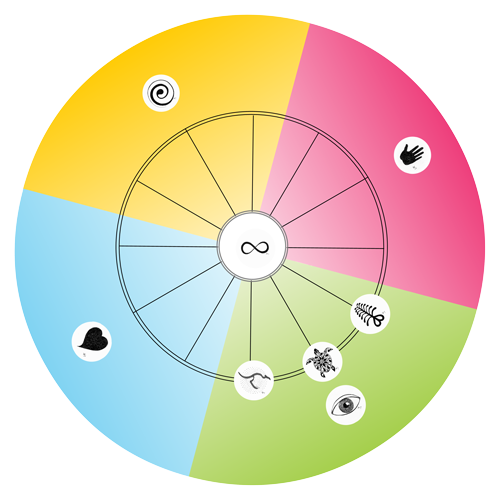
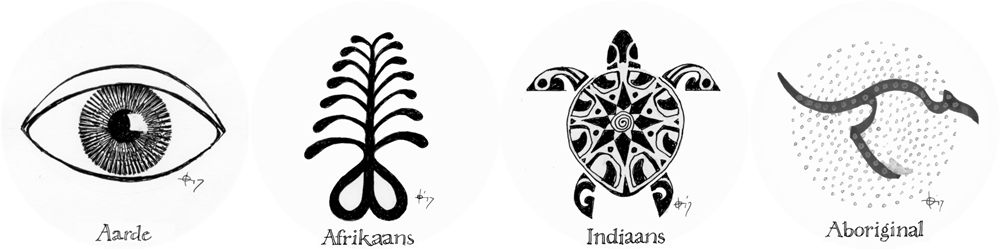
In the elementary field of ‘earth’ three icons have been placed that characterize wisdom paths of tribes and peoples living traditionally from natural contexts. In prehistoric times this ‘pre- modern’ way of life was spread all over the earth. As a result of modernization and colonization, this way of life has been reduced, but is also alive as wisdom from within each human being, and can still be found mainly within: African; Indian; and Aboriginal peoples, Maori and other indigenous peoples of Oceania.
The elementary field of water and the (inter)cultural water roads
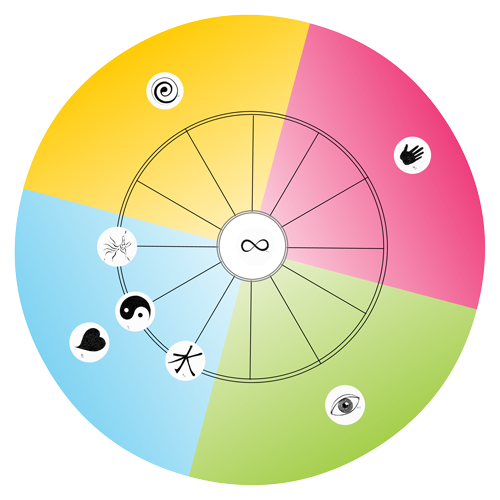
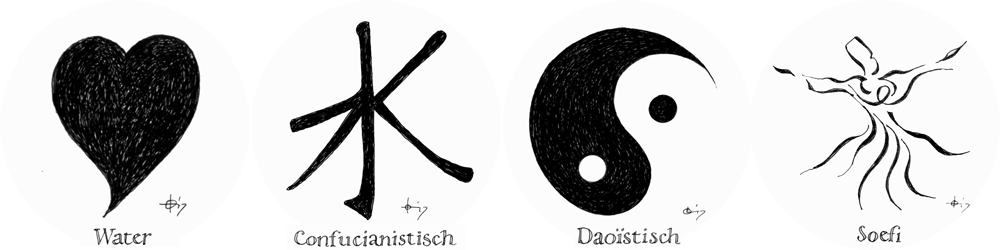
In the elementary field ‘water’ three icons have been placed that characterize wisdom roads as the natural movement of ‘go with the flow’ as well as the cosmic laws following ways of life (such as astrology).
These meandering wisdom roads can still be found as wisdom from within, as well as, for example, be recognized in wisdom traditions such as: Confucian; Dao; and Sufi movements.
The elementary field air and the (inter)cultural air roads

In the elementary field ‘air’ three icons have been placed that characterize wisdom roads as pathways of insight and breath based on wisdom traditions. This orientation can often be recognized in connection with the symbolism of light and darkness within your soul, as well as in the following perspectives:
Buddhist, advaita vedanta; gnosis, mystical and hermetic philosophy; Germanic, Celtic and Nordic mythology.

The elementary field of fire and the (inter)cultural fire roads
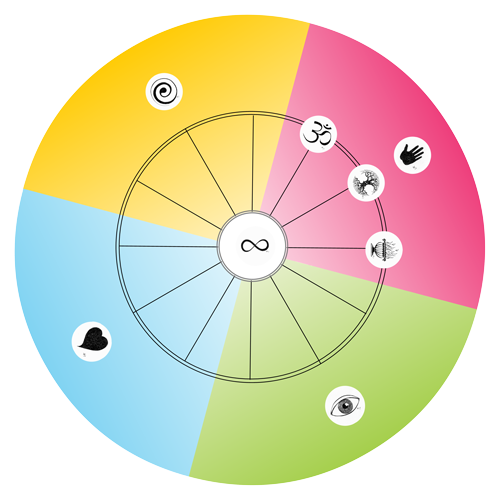
In the elementary field of ‘fire’ three icons have been placed that characterize religious and spiritual traditions, in which, especially, the meaning of fire and the struggle between good and evil, sacrifices and transformation play an important role. This orientation can be found in each individual in a different way, as well as recognized within cultural wisdom traditions such as:
animist-shamanist; Hindu; and monotheistic – zoroastrian, jewish, christian and islamic – directions.
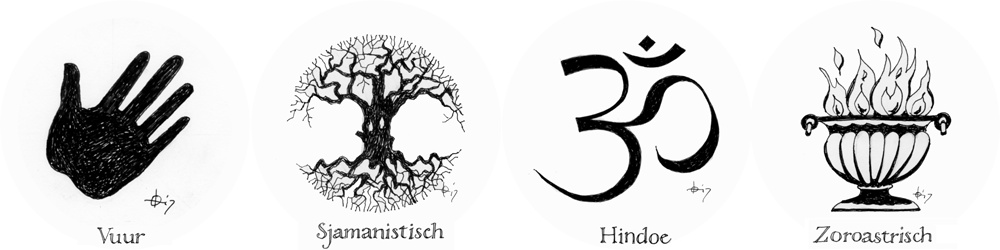
The ether field and the (inter)cultural ether roads
The ‘ether field’ symbolically refers to the fact that the longing for connection and the quest for wisdom – although culturally different and colourfully designed – occur in all human beings and cultures and is nourished by:
encounters between cultures, and profile gets through interfaces, intersections and fractures in history and
between eras.
The six dimensions
The six dimensions of the Wheel characterize wisdom in many forms on the continuum between theory and practice; multi-layered by means of different medial forms – verbal, musical, visual, ritual, narrative, dancing, … – in which the quest for wisdom is expressed.
By giving space to the diversity of medial expression, the various wisdom traditions can be highlighted in a multifaceted way, showing inter- and subcultural forms, dominant and minority voices.
For example, the elementary field of air (insight) show different paths, such as a variety of forms of ‘Buddhism’ from Zen Buddhism to mindfulness. The diverse wisdom traditions include both visions as well as forms of praxis, a mythology and other narratives and stories, cultural customs and rituals, musical and other artistic expressions of wisdom. The six dimensions of the Wheel are:
- visions, philosophy
- stories, myths,
- rituals, rituality
- symbols, symbolism
- praxis, arts and crafts
- social actuality and/or a personal vision or survival.
With these six dimensions, the Wheel expresses (inter)cultural diversity from the historical roots as well as current practices and expressions of the art of living, shown on the continuum between theory and practice.

The complete wheel
- the five elementary fields,
- the sixteen (inter)cultural avenues
- the six dimensions
The three layers form the complete Wheel of intercultural art of living.
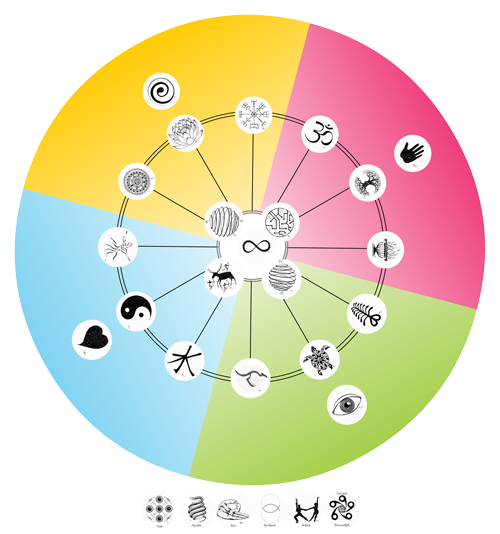
The Wheel makes visible how the periphery shows cultural diversity and the core presents connections from within, such as the transcultural value of ‘compassion’. The in- between space (between the periphery and the inner core) evokes intercultural dialogues and a cosmopolitan art of living through a Golden Ratio of wisdom traditions, like the budding of a flower which is always through nourishment from cultural roots.
update 2026-08
The Wheel of Intercultural Art of Living Read More »